Scripture memorisation has been part of Christian education for centuries, but knowing why it matters is different from knowing how to actually do it well — especially with children who lose interest after the second attempt. If you've ever watched a child recite a verse perfectly on Monday and forget it completely by Friday, you already know that memorisation isn't really about repetition. It's about method.
Here's a practical, step-by-step approach that works for most home-educated children, along with the reasons each step matters.
Step 1: Choose the Right Verse for the Right Age
Before any memory technique works, the verse itself needs to fit the child. A five-year-old struggling through a long, complex passage will associate Bible memory with frustration rather than faith. Start short:
- Ages 4–7: Single short phrases or one-line verses ("God is love," "Be kind to one another")
- Ages 8–11: Full single verses with simple sentence structure
- Ages 12+: Multi-verse passages or more complex theological language
Choosing age-appropriate material isn't about lowering expectations — it's about building genuine confidence early so children want to attempt harder passages later.
Step 2: See It Before You Say It
The biggest mistake in scripture memorisation is jumping straight to recitation. Children need to see the verse clearly and repeatedly before they're asked to recall it. Write it out, display it somewhere visible, or have your child copy it by hand. The act of writing engages a different part of memory than simply hearing it read aloud, and it slows the brain down enough to notice the actual words rather than skimming past them.
Step 3: Break It Into Chunks
Long verses feel impossible when treated as one block of text. Instead, break the verse into 3–5 word phrases and master each phrase individually before linking them together. This is sometimes called "chaining" — once chunk one is solid, add chunk two, then practise one-and-two together, then add chunk three, and so on. It feels slower at first but produces far stronger long-term retention than trying to swallow the whole verse at once.
Step 4: Use Gap-Fill Practice
Once a child can read a verse confidently, the next stage is partial recall. Remove a few words and ask them to fill in the blanks. This is the bridge between "recognising" a verse and truly "knowing" it. Gap-fill exercises force the brain to actively retrieve information rather than passively recognise it — and active retrieval is what actually builds durable memory.
Step 5: Full Recall, Without Prompts
The final stage is reciting the verse from memory with no visual aid at all. This should always come after the gap-fill stage, never before — asking a child to recall a verse cold before they've had structured practice usually leads to guessing, frustration, and a sense of failure that has nothing to do with their actual ability.
Step 6: Review on a Schedule, Not Just Once
This is the step most families skip, and it's the one that matters most. A verse memorised once and never revisited will fade within weeks. Spaced repetition — reviewing a verse a day later, then a week later, then a month later — is what moves scripture from short-term memory into something a child carries for life. This is precisely why simple flashcard repetition, on its own, tends to underperform: without a system tracking when to review what, verses quietly slip away.
Step 7: Make It Routine, Not a One-Off Event
Five focused minutes a day will outperform one stressful 30-minute session every time. Children build memorisation skill the same way they build any other skill — through small, consistent repetition rather than occasional intensity.
Bringing the Steps Together
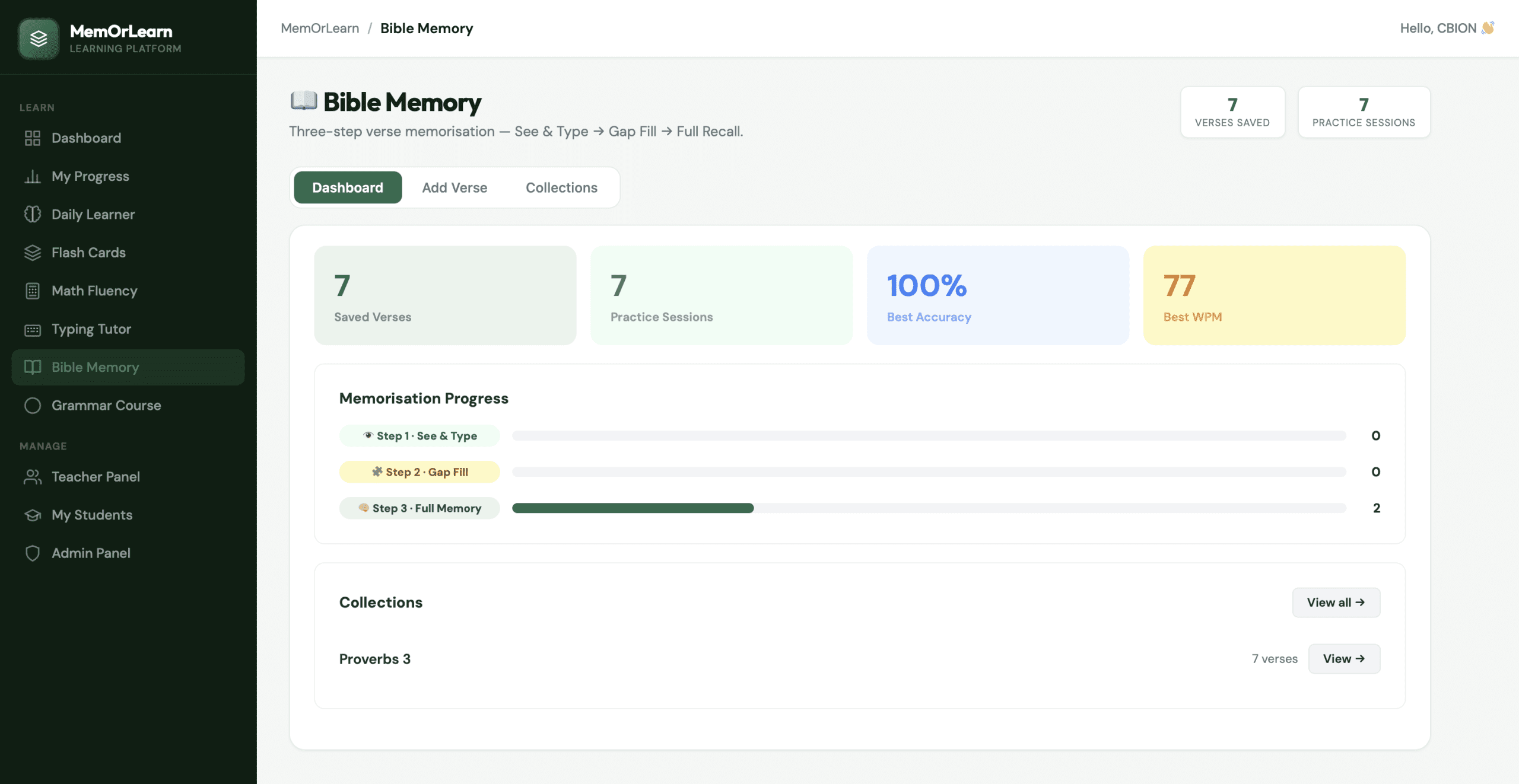
Each of these steps works on its own, but they work far better as a connected system rather than scattered techniques. That's exactly the gap MemOrLearn's Bible Memory module was built to close. It walks students through the same three-stage progression outlined above — See & Type, Gap Fill, and Full Recall — with verses organised into collections, support for multiple Bible translations, and built-in spaced repetition so review happens automatically rather than being one more thing for a parent to remember.
For homeschool families juggling scripture alongside maths, typing, and grammar, having one place where Bible memory follows a proven method — and quietly tracks what needs reviewing next — tends to make the difference between a verse a child recited once and a verse a child still knows ten years from now.
If you'd like to see the method in action, MemOrLearn offers a 14-day free trial, no card required.