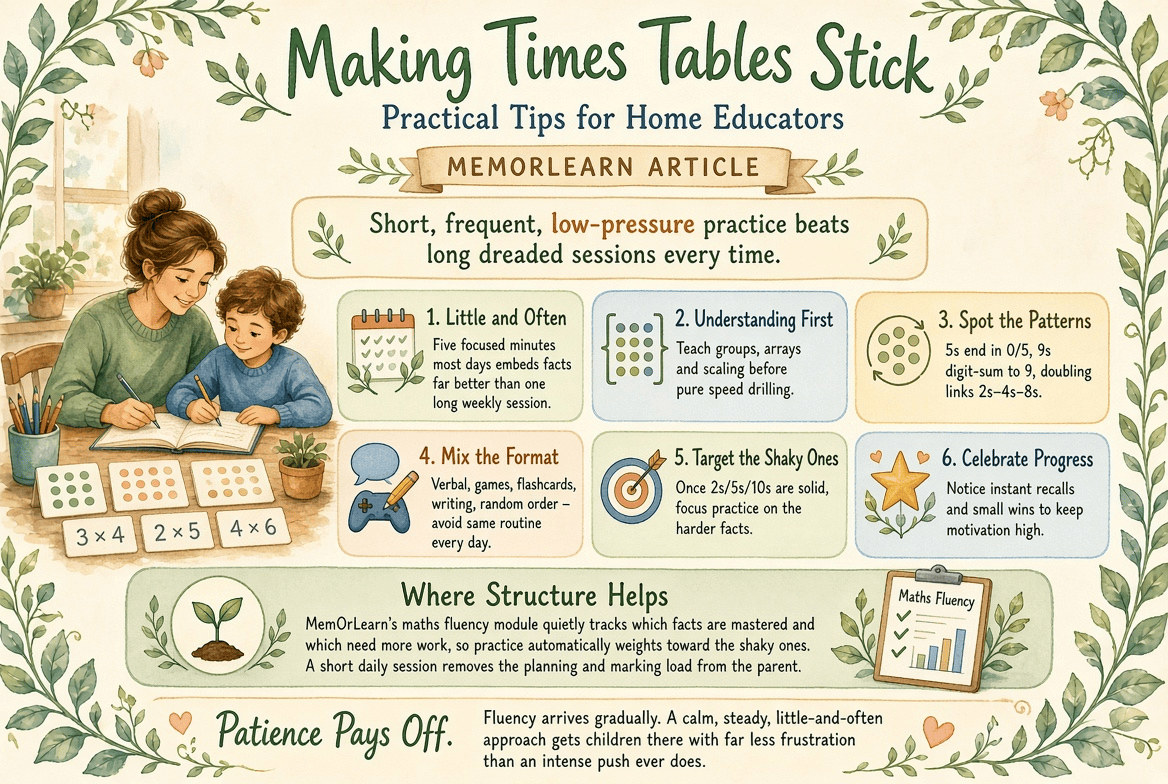
Few topics generate as much quiet dread in home educating households as times tables. Every parent knows they matter, most remember the slog of learning them, and yet getting them to actually stick — rather than being re-learned every September — can feel oddly difficult to crack. The good news is that a handful of practical habits make a real difference, and none of them require turning maths time into a battle.
Why Times Tables Are Worth the Effort
Times tables aren't just a memorisation exercise for its own sake. Fluent recall frees up mental space for everything that builds on it — long multiplication, division, fractions, percentages, algebra later on. A child who has to labouriously work out 7 x 8 from scratch every time struggles far more with the next layer of maths than one who can recall it instantly, simply because so much working memory gets used up on the basic fact instead of the new concept being taught.
Little and Often Beats Long and Rare
The single most consistent finding about times tables is that short, frequent practice beats occasional long sessions. Five focused minutes most days embeds facts into long-term memory far more effectively than a single 45-minute session once a week. If times tables practice is currently an occasional, dreaded event, shrinking it down to a genuinely small daily habit is usually the biggest single improvement you can make.
Teach Understanding Before Drilling Speed
Rote memorisation works better once a child genuinely understands what multiplication represents — repeated groups, arrays, scaling. A child who understands that 4 x 6 means four groups of six (and can picture or build that with objects) tends to retain the fact more securely than one who's only ever seen it as an abstract sum to recite. Spending time on understanding early on, even if it feels slower, tends to pay off in retention later.
Use Patterns, Not Just Raw Memorisation
Times tables are full of patterns that make them far less daunting once spotted: the 5 times table always ends in 0 or 5, the 9 times table has a well-known finger trick and digits that always sum to 9, doubling gets you from the 2s to the 4s to the 8s. Pointing out these patterns explicitly, rather than expecting a child to notice them alone, often turns an intimidating wall of 144 facts into a much smaller set of genuinely new information.
Mix Up the Practice Format
Repetition in exactly the same format (chanting, or the same worksheet every day) tends to get tedious fast and can lead to a child memorising the order of a specific list rather than the facts themselves. Varying the format — verbal quizzing in the car, a quick game, flashcards, an app, writing facts out, mixed random-order questions — keeps engagement higher and tests genuine recall rather than sequence memory.
Focus on the Facts That Aren't Yet Secure
Once the easier tables (2s, 5s, 10s) are solid, it's tempting to keep drilling the whole set from the start every time. It's usually far more efficient to identify which specific facts are still shaky — often ones like 7 x 8, 6 x 7, 8 x 9 — and spend the bulk of practice time there, rather than repeatedly re-covering facts that are already secure.
Celebrate Progress, Not Just Mastery
Times tables can take months to fully embed, and a child who only hears about the facts they've got wrong can quickly start to dread practice altogether. Noticing and celebrating genuine progress — "you got that one instantly this time" — tends to keep motivation up far better than focusing purely on the gaps still remaining.
Where a Bit of Structure Helps
Tracking which facts are solid and which need more work is genuinely fiddly to do by hand, especially across more than one child. This is one area where a tool like MemOrLearn's maths fluency module does some quiet, useful work in the background — it tracks exactly which facts a child has mastered and which need repeating, so practice naturally weights toward what's actually still shaky, rather than a parent having to work that out manually each week.
For families short on time or confidence in this area, a short daily session on a platform like this can also simply take the daily "right, let's do times tables" decision off your plate entirely — the structure is already there, ready to go, without needing you to plan or mark anything.
Patience Pays Off
Times tables fluency tends to arrive gradually rather than all at once, and there's rarely a shortcut around the basic need for consistent, low-pressure practice over time. A calm, steady, little-and-often approach — understanding first, patterns noticed, practice varied, progress celebrated — tends to get children to genuine fluency with far less tears and frustration than an intense, high-pressure push ever does.