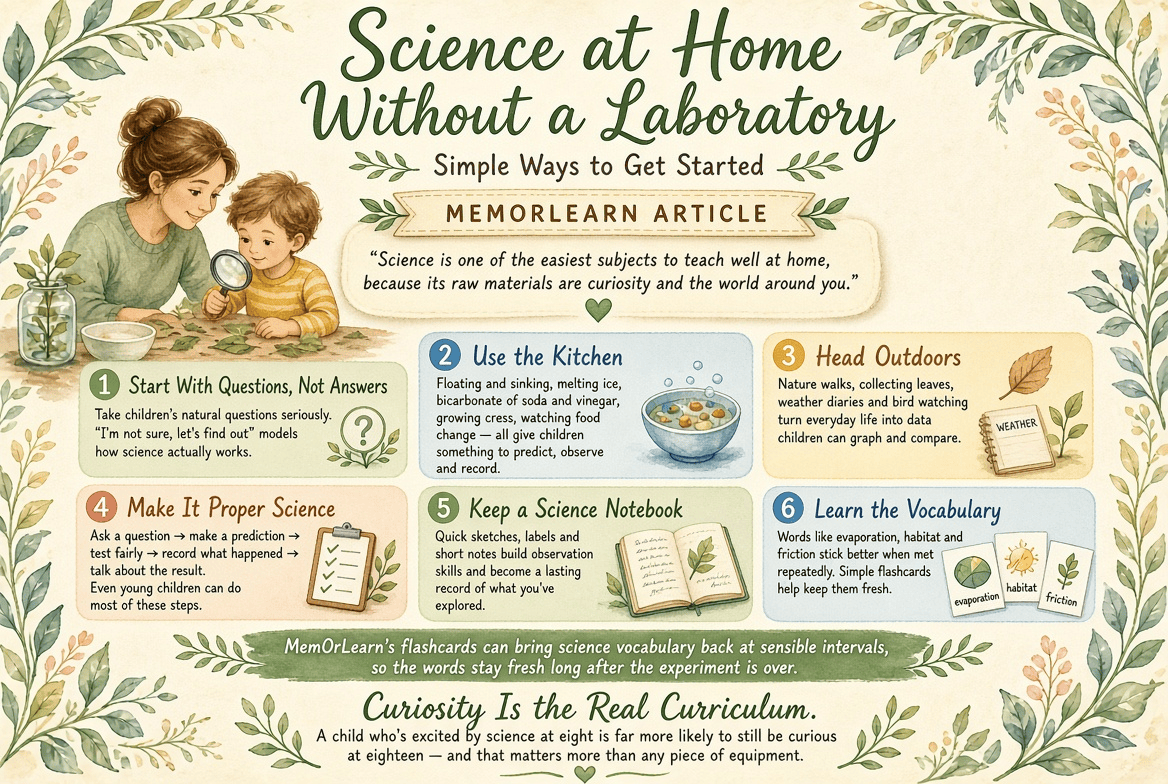
Science can feel like the subject most likely to get left behind in a home education household. There's no lab, no specialist equipment and possibly no confidence in the subject. In reality, it's one of the easiest to teach well, because its raw materials are curiosity and the world around you. Here are practical ways to get started.
Start With Questions, Not Answers
Children are natural scientists. They ask why the sky is blue, where puddles go and what's inside a conker. A good home science education mostly means taking those questions seriously. You don't need all the answers. Saying "I'm not sure, let's find out" and then working it out together shows your child exactly how science works.
Use the Kitchen
The kitchen is a fantastic laboratory. Simple experiments include:
- Seeing what floats and what sinks in the washing-up bowl
- Melting ice cubes in different places to see which melts fastest
- Mixing bicarbonate of soda and vinegar to see what happens
- Growing cress on damp kitchen roll
- Leaving a banana or slice of bread in a bag and tracking the changes
Each one gives children something to predict, observe and record.
Head Outdoors
A seasonal nature walk is a science lesson in itself. Autumn and winter are perfect for collecting and sorting leaves, noticing which birds have arrived or gone, and discussing why trees lose their leaves. A simple weather diary, noting temperature, cloud cover and rainfall each day, turns everyday life into data that children can graph and compare over several weeks.
Make It Proper Science
What turns an activity into science, rather than just fun, is a simple routine:
- Ask a question
- Make a prediction
- Test it fairly, changing only one thing at a time
- Record what happened
- Talk about whether the result matched the prediction
Even very young children can do the first, second and last steps, and older children can begin to think about fair testing, which is a key idea in primary and secondary science.
Keep a Science Notebook
A simple notebook with drawings, labels and short notes builds observation and recording skills, and gives you a lasting record of what you've explored. It doesn't need to be neat. A quick sketch and a sentence about what happened is plenty, and the notebook becomes a keepsake as well as evidence of learning.
Use Books and Documentaries
Some of science is hard to demonstrate at home, such as space, the human body or how electricity works. Library books and good documentaries fill that gap, and they spark new questions to investigate. Reading about a scientist or an invention often leads naturally to a related experiment.
Learn the Vocabulary
Science comes with its own words, such as evaporation, habitat, friction and condensation. These are easier to remember when children meet them repeatedly. A set of simple flashcards for each topic helps, and a tool such as MemOrLearn's flashcards can bring the words back at sensible intervals, so the vocabulary stays fresh long after the experiment is over.
Stay Safe and Keep It Manageable
Supervise anything involving heat, sharp tools or chemicals, even household ones, and check that experiments are suitable for your child's age. Keep things simple. One or two short activities a week, with a bit of follow-up talk or drawing, is plenty, and it's far better to do a little regularly than a big project occasionally.
Track What You've Covered
It's easy to lose track of what you've explored, particularly with child-led science. A short list of topics in your notebook, or progress records from a platform such as MemOrLearn for the vocabulary work, can show you what you've covered and where you might go next.
Curiosity Is the Real Curriculum
The most valuable thing you can give a young scientist is a sense that questions are welcome and that finding things out is enjoyable. A child who's excited by science at eight is far more likely to still be curious at eighteen, and that curiosity matters far more than any piece of equipment.