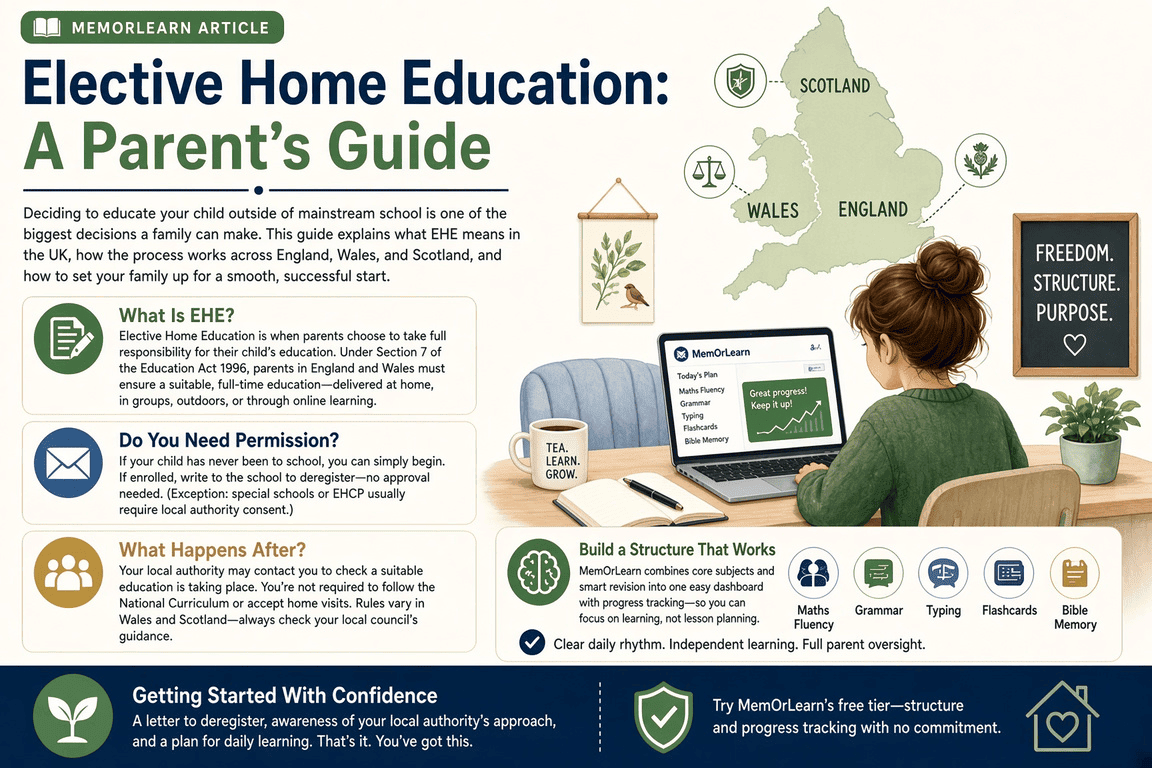
Deciding to educate your child outside of mainstream school is one of the biggest decisions a family can make — and if you're in the UK, you'll quickly come across a term that doesn't get used much elsewhere: Elective Home Education, or EHE. It's the official term for what many parents simply call home educating, and understanding how it actually works can turn an overwhelming decision into a manageable, confident one.
This guide walks through what EHE means, how the process works across England, Wales, and Scotland, and how to set your family up for a smooth, successful start.
What Is Elective Home Education?
Elective Home Education is the legal term used when parents choose to take full responsibility for their child's education, rather than sending them to a state or independent school. The word "elective" matters here — it distinguishes families who choose to home educate from children who are out of school for other reasons, such as illness or exclusion.
Under Section 7 of the Education Act 1996, parents in England and Wales are responsible for ensuring their child receives a suitable, full-time education — but that education doesn't have to happen at school. It can happen at the kitchen table, at a local home education group, on a nature walk, or through an online learning platform like MemOrLearn. The law gives parents significant freedom in how they deliver that education, as long as it's suitable for the child's age, ability, and any additional needs.
Do You Need Permission to Home Educate?
If your child has never been registered at a school, you don't need anyone's permission to home educate — you can simply begin.
If your child is currently enrolled at a school, the process is a little different. You'll need to formally deregister them by writing to the school (a simple letter is usually enough) stating that you're removing them to home educate. The school is then legally required to remove your child's name from its admission register and notify the local authority. You don't need the school's approval — deregistration is your right as a parent, though schools will sometimes ask you to confirm your reasons or offer a meeting first.
One important exception: if your child attends a special school, or has an Education, Health and Care Plan (EHCP), you'll usually need the local authority's consent before deregistering, since their placement was arranged differently.
What Happens After You Deregister?
Once your child is off the school roll, your local authority may make contact to check that a suitable education is taking place. This isn't a formal inspection, and there's no legal requirement in England for parents to follow the National Curriculum, sit exams, or submit to home visits. Many local authorities will invite you to share information about your approach — sometimes through a written report, sometimes an informal chat — but you're entitled to decline a home visit and communicate in writing instead.
Wales operates slightly differently, with local authorities taking a somewhat more structured monitoring role, and Scotland's approach differs again — in Scotland, if your child has never attended school you don't need consent to home educate, but if they're already enrolled, you may need your council's permission to remove them, which isn't the case in England or Wales.
Because the rules vary by nation and can be interpreted differently by individual local authorities, it's always worth checking your specific council's current guidance, or connecting with a home education support organisation, before you begin.
Building a Structure That Actually Works
One of the biggest adjustments for new home educating families isn't legal — it's practical. Without the built-in structure of a school day, many parents worry about whether their child is progressing, staying consistent, or covering the right ground.
This is where having the right tools makes a genuine difference. A platform like MemOrLearn takes the guesswork out of daily learning by combining core subjects — maths fluency, grammar, typing, flashcard-based revision, and Bible memory — into one dashboard, with built-in progress tracking so you can see, at a glance, how your child is actually doing. Instead of juggling five different apps or worksheets, you get a clear daily rhythm your child can follow independently, while you retain full oversight of their progress.
For families new to EHE, that kind of structure can be reassuring in the early weeks — not because the law requires it, but because you'll want the confidence that comes from seeing consistent, measurable progress.
Getting Started With Confidence
Elective Home Education gives UK families real freedom to shape an education around their child, rather than the other way around. The legal process is more straightforward than most new parents expect — a letter to deregister, an awareness of your local authority's approach, and a plan for how you'll structure learning day to day.
From there, the real work is simply building a rhythm that suits your family: some structure, some flexibility, and tools that make consistent progress easy to maintain without turning every day into a battle over the kitchen table.
If you're just starting out, MemOrLearn's free tier is a low-pressure way to bring some of that structure into your first weeks of home educating — no commitment required while you find your feet.