Math fact fluency is one of the most valuable foundations you can give a child. It’s the difference between a student who freezes on multi-step problems and one who moves confidently through algebra, geometry, and beyond. Yet many homeschool families struggle with the how: endless worksheets lead to boredom, random drills create frustration, and without a clear system, facts that seemed mastered one week vanish the next.
Here’s a practical, step-by-step approach that builds real fluency—speed and accuracy—while keeping children motivated and reducing parent oversight.
Step 1: Assess Where Your Child Actually Is
Before drilling facts, know the starting point. Many children appear weak in multiplication when the real gap is in addition or subtraction. Spend time identifying which specific facts (e.g., 7 + 8, 6 × 9) cause hesitation or errors.
This prevents wasting time on already-strong areas and builds early wins that encourage effort. Age-appropriate targets help too:
- Ages 6–8: Focus on addition and subtraction facts to 20.
- Ages 9–11: Emphasize multiplication and division tables.
- Ages 12+: Refine speed and mix operations for mental math confidence.
Step 2: See It, Say It, and Write It
Don’t jump straight into timed tests. Children need to understand and visualize the facts first. Display fact families (e.g., 6 + 7 = 13, 7 + 6 = 13, 13 – 6 = 7), have your child copy them, or use visual aids like number lines or ten-frames.
Writing engages multiple senses and helps the brain notice patterns rather than treating facts as isolated random information.
Step 3: Break Facts into Manageable Groups
Tackling all 100 multiplication facts at once feels overwhelming. Group them strategically—by fact families, by difficulty (e.g., easiest doubles first), or by operation. Master a small set thoroughly before adding more. This “chaining” approach builds momentum: once a group is solid, combine it with the next.
Step 4: Use Targeted, Adaptive Practice with Timed Drills
Shift from passive review to active recall. Short, focused timed sessions work far better than long marathons. Tools that adapt to the child’s performance—showing more problems on weak facts and fewer on mastered ones—maximize efficiency.
Mix in variety: standard drills for accuracy, then “race” or streak challenges for speed. Immediate feedback after each answer helps correct errors on the spot before bad habits form.
Step 5: Track Mastery Visually and Prioritise Weak Areas
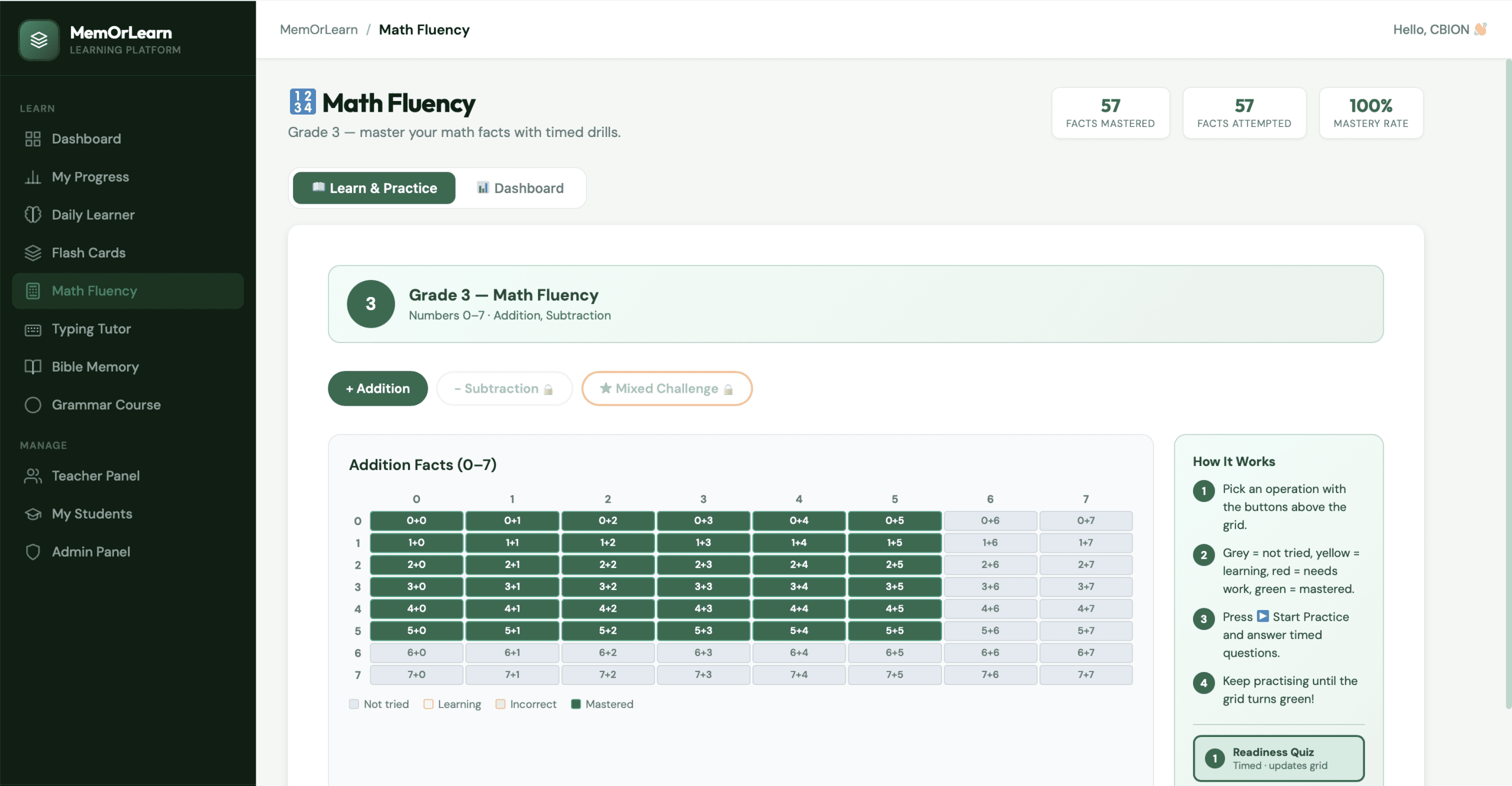
One of the biggest game-changers is a clear visual system showing which facts are mastered (e.g., green), still learning (yellow), or needing work (red). This turns abstract progress into something tangible. Regularly review only the shaky facts rather than re-drilling everything equally.
Step 6: Incorporate Spaced Review and Daily Consistency
Fluency isn’t built in one intense session. Short daily practice (even 5–10 minutes) combined with spaced repetition—reviewing facts at increasing intervals—moves them into long-term memory. Without this, facts fade quickly.
Step 7: Make It Engaging and Integrated
Link math facts to real life, games, or other subjects. Celebrate streaks and visible progress. Combine with typing practice (typing equations) or use facts within word problems to show relevance. Consistency and small wins keep motivation high.
Bringing the Steps Together
These techniques work individually, but they shine as part of a connected system. That’s where MemOrLearn’s Math Fluency module excels. It offers timed drills for addition, subtraction, multiplication, and division with a smart adaptive mastery system.
The platform tracks every individual fact, uses color-coded grids to show progress at a glance (grey = not tried, yellow = learning, red = needs work, green = mastered), and automatically prioritises weak areas. Features like Readiness Quizzes and Race Quizzes build both accuracy and speed. Students choose or lock a grade level for tailored practice, and everything integrates with the dashboard for easy parent oversight.
For homeschool families balancing math with Bible memory, typing, grammar, and more, having one platform that handles the tracking, adaptation, and spaced elements quietly in the background makes all the difference—freeing you to focus on teaching concepts rather than managing drills.
And see our other articles here: Math Fact Fluency: The Complete Guide for Homeschool Families - What Is Math Fact Fluency (and Why It Matters More Than You Think) - What Is Math Fact Fluency and How Homeschoolers Build It Fast