If you’ve ever watched your child struggle with multi-digit multiplication or word problems because they’re still counting on their fingers, you’re not alone. Math fact fluency is one of the most important foundational skills in early maths — and one that many homeschool families want to strengthen.
In this guide, we’ll explain exactly what math fact fluency is, why it matters so much, and practical ways to build it effectively at home.
What Is Math Fact Fluency?
Math fact fluency is the ability to recall basic addition, subtraction, multiplication, and division facts quickly, accurately, and automatically — without needing to count or use fingers.
Think of it as moving from “figuring it out” to instant recall. A fluent student might see 7 × 8 and immediately know 56, freeing up mental energy for harder concepts like fractions, long division, or algebra.
True fluency includes four key elements:
- Accuracy — Getting the right answer
- Efficiency — Solving it quickly
- Flexibility — Using strategies or derived facts (e.g., knowing 6 × 8 = 48 because 3 × 8 = 24 and doubling it)
- Automaticity — Retrieving the fact in 2–3 seconds or less
It’s not just rote memorisation or timed drills. The best approach combines understanding, strategy, and purposeful practice.
Why Math Fact Fluency Matters for Homeschoolers
Strong fact fluency:
- Frees up working memory for complex problem-solving
- Builds confidence and reduces maths anxiety
- Supports success in higher maths topics
- Saves time during daily lessons
Research consistently shows that students who achieve fluency perform better in later maths.
For homeschool families, this is especially valuable — you can provide consistent, personalised practice without the pressure of a crowded classroom.
How to Build Math Fact Fluency at Home
Here are proven strategies that work well for homeschoolers:
- Start with Understanding, Not Just Memorisation Help your child see patterns and relationships (e.g., multiplication as repeated addition or arrays). Use manipulatives, number lines, or visual models.
- Daily Short Practice Consistency beats marathon sessions. Just 10–15 minutes a day is highly effective.
- Use Spaced Repetition and Active Recall Review facts at increasing intervals and test retrieval instead of passive review.
- Mix Games and Variety Turn practice into play with card games, dice activities, or digital tools.
- Track Progress Visually Celebrate small wins with progress dashboards or charts.
The Best Tool for Building Math Fact Fluency: MemOrLearn
This is where an all-in-one platform like MemOrLearn works well for busy homeschool families.
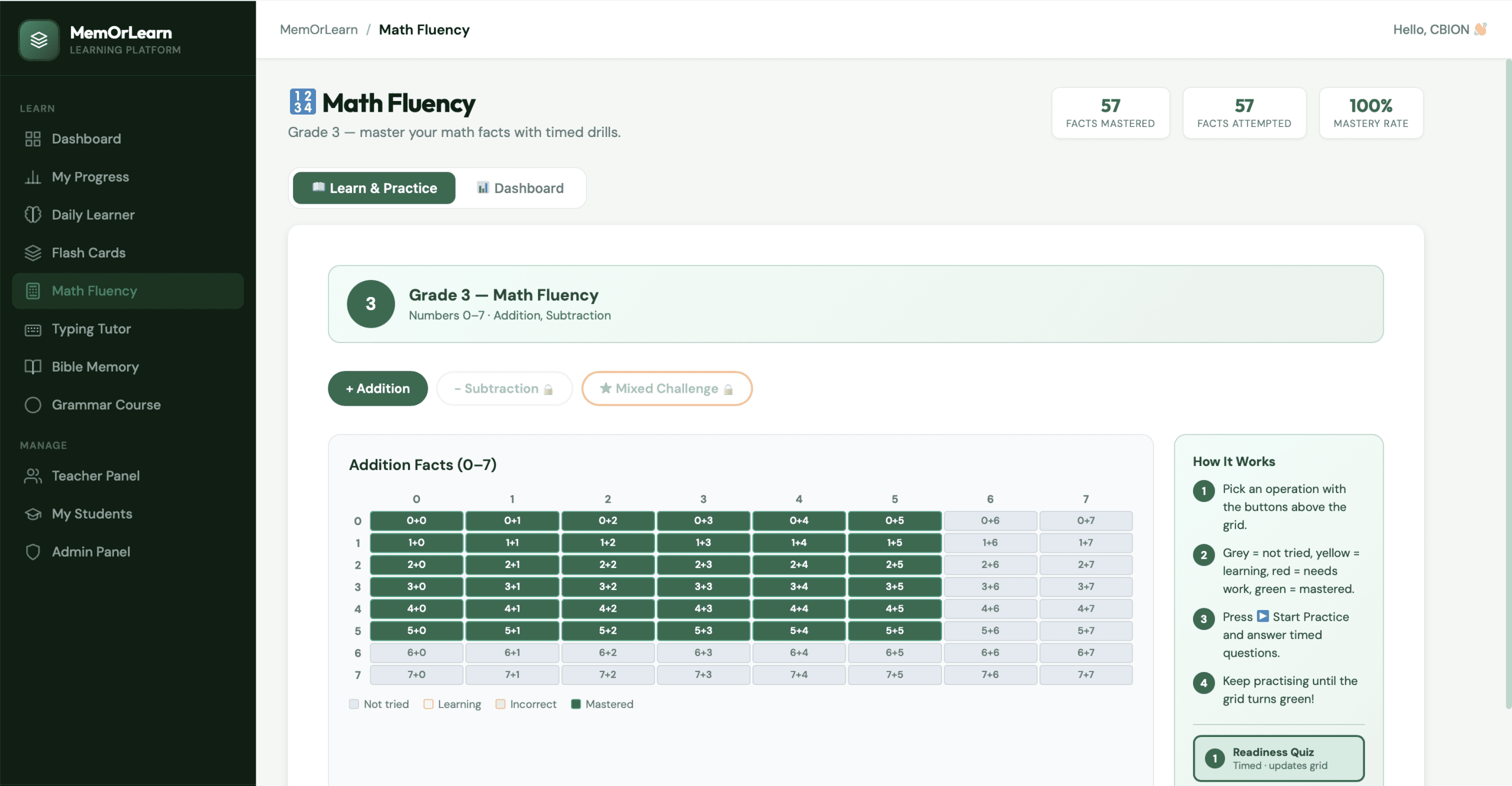
Our Math Fact Fluency module combines:
- Adaptive practice that focuses on the facts your child needs most
- Built-in spaced repetition for long-term memorisation
- Engaging, low-pressure format that feels like a game
- Detailed progress tracking so you can see exactly where your student is improving
Because it’s part of the full MemOrLearn system, your child can seamlessly switch between math facts, flashcards for other subjects, typing practice, grammar, and Bible memorisation — all in one place with unified progress reports.
Many parents find that combining conceptual understanding with daily adaptive practice helps kids achieve fluency faster and with less frustration.
Quick Start Tips for Today
- Assess which facts need work (addition/subtraction first, then multiplication/division)
- Set a daily 10-minute routine
- Praise effort and strategy use (“I love how you derived that fact!”)
- Use MemOrLearn’s teacher/parent dashboard to monitor growth
Ready to build strong math fact fluency?
See our website for sign up options and try the free demo!
And see our other articles here: Math Fact Fluency: The Complete Guide for Homeschool Families - What Is Math Fact Fluency (and Why It Matters More Than You Think) - How to Build Strong Math Fact Fluency: A Step-by-Step Guide for Homeschool Families