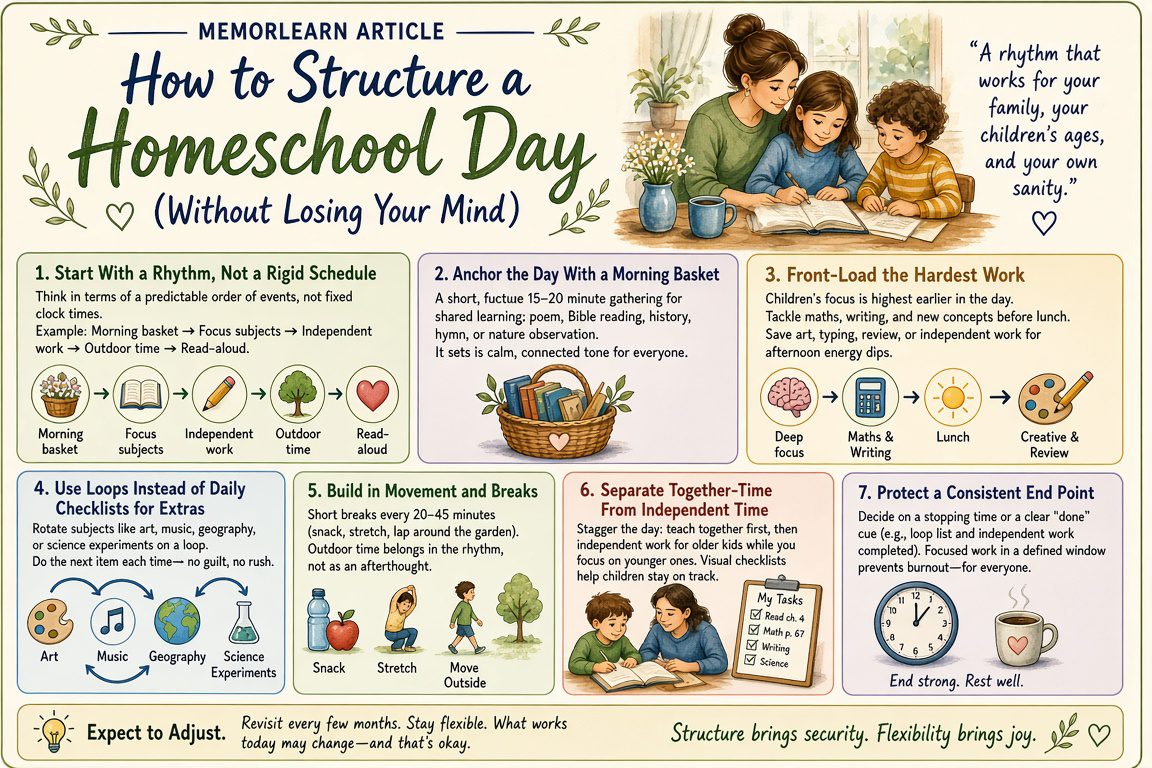
Start With a Rhythm, Not a Rigid Schedule
Many new homeschoolers try to replicate a school timetable at home, with subjects locked into specific time slots. This often backfires, especially with younger children or multiple kids at different levels. Instead, think in terms of a rhythm: a predictable order of events rather than fixed clock times. For example, your day might always move through "morning basket, focus subjects, independent work, outdoor time, read-aloud" — regardless of whether that takes three hours or five. A rhythm gives children the security of knowing what comes next without the stress of watching a clock.
Anchor the Day With a Morning Basket
A morning basket is a short, cosy block at the start of the day where the whole family gathers for shared learning: a poem, a Bible reading, a bit of history read-aloud, a hymn, or a nature observation. It doesn't need to take more than fifteen to twenty minutes, but it sets a calm, connected tone before the more demanding academic work begins. Families with children of very different ages often find the morning basket is the one part of the day everyone can do together.
Front-Load the Hardest Work
Children's focus and willingness tend to be highest earlier in the day, so it makes sense to schedule the subjects that require the most concentration — maths, writing, new concepts — before lunch. Save more independent or lower-effort activities, like art, typing practice, or review work, for the afternoon when energy naturally dips. This isn't a hard rule, but it's a helpful default if you're not sure where to start.
Use Loops Instead of Daily Checklists for Extras
Not every subject needs to happen every single day. Subjects like art, music appreciation, geography, or science experiments often work better on a rotating "loop" — you simply do the next item on the list each time that slot comes around, rather than trying to squeeze in every subject daily. This removes the guilt of a missed day and keeps the extras from crowding out the core work.
Build in Movement and Breaks
Children, especially younger ones, cannot sustain long stretches of seated academic work. Plan short breaks every 20 to 45 minutes depending on age — a snack, a stretch, a lap around the garden. These breaks aren't wasted time; they're what makes the following work session actually productive. Outdoor time in particular deserves a fixed spot in the rhythm rather than being treated as an optional extra squeezed in "if there's time."
Separate Together-Time From Independent Time
As children get older, they can handle more independent work, but younger siblings often still need one-on-one instruction. A common solution is to stagger the day: start with subjects you teach together, then move older children into independent or workbook-based tasks while you give focused attention to younger ones. Having a visual task list or checklist for older kids to follow on their own can make this transition much smoother.
Protect a Consistent End Point
Just as a clear start to the day matters, so does a clear end. Homeschooling can expand to fill every available hour if you let it, which leads to burnout for both parents and children. Decide on a rough stopping point — whether that's a specific time or "once the loop list and independent work are done" — and stick to it. Consistency here teaches children that focused work in a defined window is more valuable than dragging tasks out all day.
Expect to Adjust
No schedule survives first contact with a sick child, a rainy week, or a season of life that changes your family's needs. The families who feel calmest about homeschooling aren't the ones who never deviate from a plan — they're the ones who treat their rhythm as a flexible framework, not a contract. Revisit your structure every few months and adjust it as your children grow and your circumstances change.
A well-structured homeschool day isn't about packing in more subjects or following someone else's timetable perfectly. It's about creating a rhythm that gives your children security, protects your energy as a parent, and leaves room for the flexibility that homeschooling was meant to offer in the first place.