If you've spent any time researching math curriculum for your homeschool, you've probably run into the term "math fact fluency." It sounds like educational jargon, but it describes something every parent has actually witnessed: the difference between a child who has to stop and count on their fingers for 7+8, and one who just knows it's 15 without thinking.
That instant, automatic recall is math fact fluency — and it turns out to be one of the strongest predictors of how comfortable a child feels with math for years to come.
What Math Fact Fluency Actually Means
Math fact fluency is the ability to recall basic arithmetic facts — addition, subtraction, multiplication, and division within a certain range — quickly, accurately, and without conscious effort. It covers things like:
- Knowing that 6 × 7 = 42 instantly, rather than working it out
- Recalling that 12 − 5 = 7 without pausing to count backward
- Recognizing number relationships (like knowing 8 + 8 = 16, so 8 + 9 must be 17)
It's different from simply "knowing how" to add or multiply. A child can understand the concept of multiplication perfectly well and still lack fluency if they have to reconstruct 9 × 6 from scratch every single time.
The Benefits of Building Math Fact Fluency
It frees up working memory for harder problems. This is the big one. Working memory — the mental scratchpad kids use to hold information while they think — is limited. If a child has to spend it calculating 7 × 8 in the middle of a long division problem, they have less brainpower left to track the actual steps of the problem. Fluent recall means that mental energy goes toward the new, harder skill instead.
It builds confidence and reduces math anxiety. Kids who constantly feel slow or unsure with basic facts often start to believe they're "just not a math person." Fluency flips that narrative early, before math anxiety has a chance to take root.
It makes multi-step math and word problems accessible. Fractions, algebra, area and volume, multi-digit multiplication — nearly everything past third or fourth grade assumes fast fact recall as a baseline. Without it, every new topic becomes twice as hard because kids are solving two problems at once: the new concept, and the arithmetic underneath it.
It supports real-world number sense. Fluent kids estimate better, catch their own errors faster, and handle mental math (tips, measurements, quick totals) with far more ease as adults.
It compounds over time. Fluency built in first and second grade with addition and subtraction pays off in third grade multiplication, which pays off in fourth grade division, which pays off in fractions. Each stage is easier when the previous one is solid — and harder when it isn't.
It's highly trainable with short, consistent practice. Unlike some academic skills that take years to shift, fact fluency responds well to brief, frequent practice — often just 5-10 minutes a day of the right kind of drilling, especially when it mixes timed recall with spaced repetition so facts move into long-term memory rather than short-term cramming.
A Few Things Worth Watching For
Fluency drills aren't a substitute for conceptual understanding — a child should grasp why 4 × 3 = 12 (equal groups, arrays, repeated addition) before or alongside memorising that it does. Drilling facts a child doesn't conceptually understand yet can turn into rote memorization without real number sense underneath it.
Timed drills can also occasionally spike anxiety in kids who are naturally more anxious about being watched or timed, so it's worth pairing fluency practice with a low-pressure, private setting rather than a public or competitive one, at least at first.
Finally, fluency practice needs to be spaced out and reviewed over time, not crammed. A single intense week of drilling won't stick nearly as well as a few minutes daily over months, since long-term recall depends on facts being revisited just as they start to fade.
Building Fluency at Home
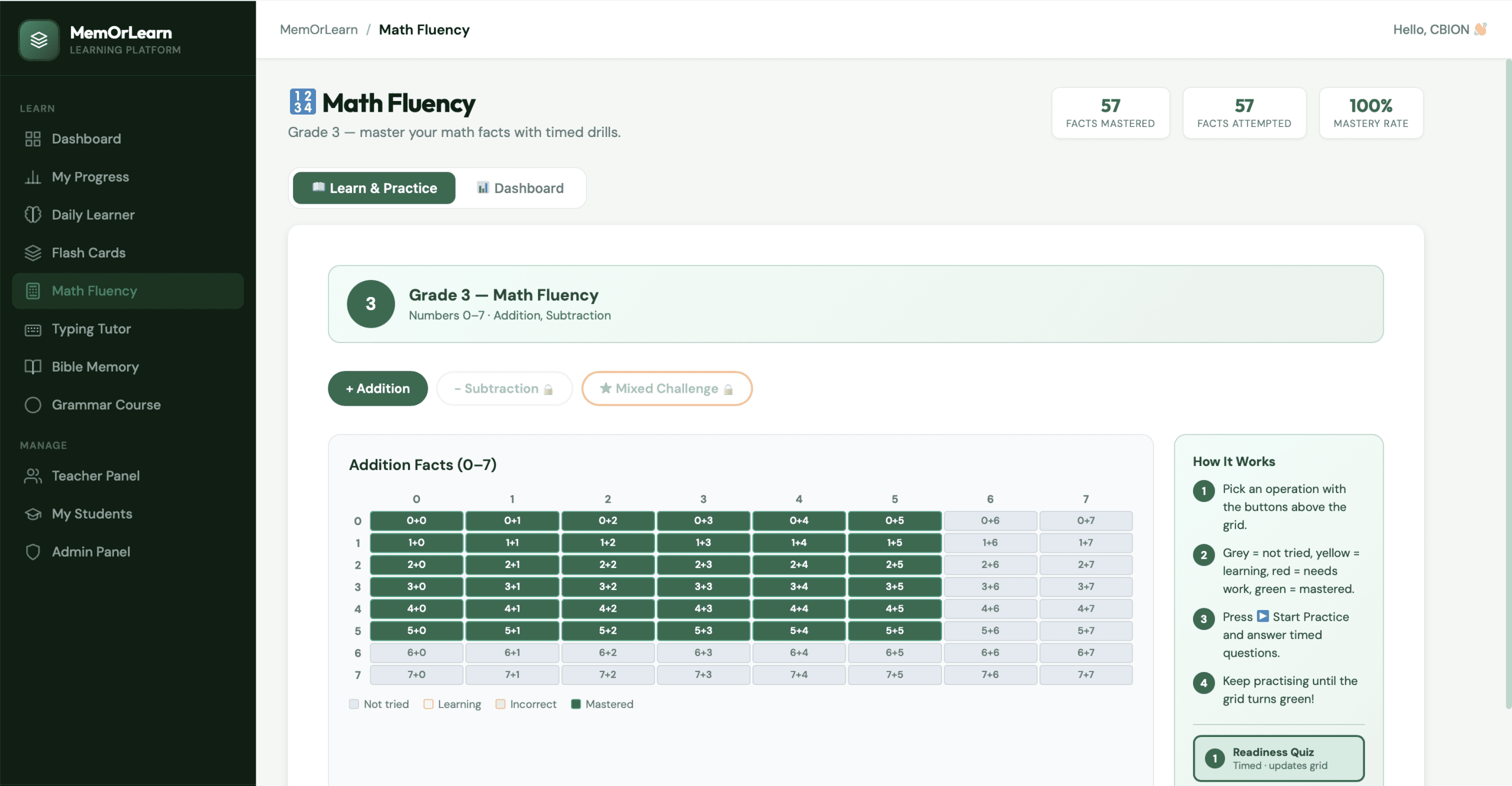
The good news is that fact fluency is one of the most homeschool-friendly skills to build, precisely because it responds so well to short, daily, low-stakes practice — which is exactly the kind of routine a home environment is good at providing. Tools that track which facts a child has mastered and which ones need more repetition (rather than drilling everything equally) tend to build fluency faster, since they focus practice time where it's actually needed.
MemOrLearn's Math Fluency module is built around exactly this idea — short daily drills that adapt to where each child's gaps are, so fluency builds steadily without turning math time into a battle.
Read similar articles below:
What Is Math Fact Fluency and How Homeschoolers Build It Fast
How to Build Strong Math Fact Fluency: A Step-by-Step Guide for Homeschool Families
Math Fact Fluency: The Complete Guide for Homeschool Families