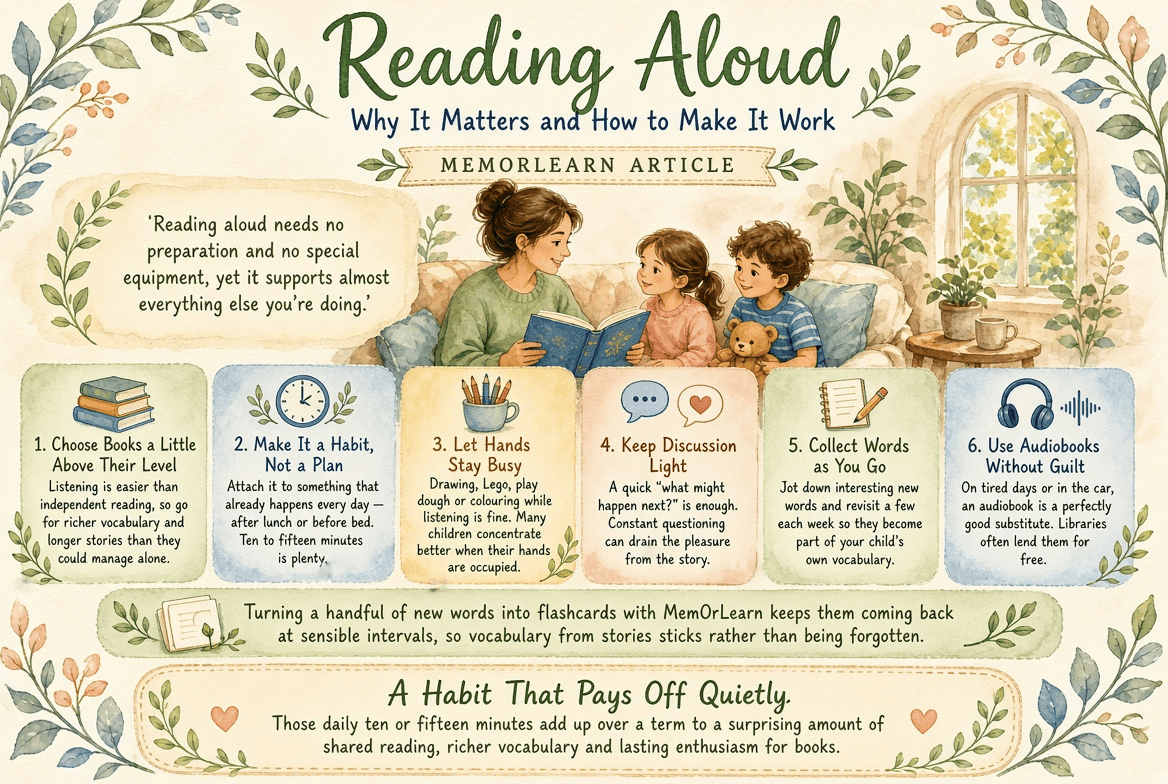
Ask experienced home educators which habit they'd never give up, and reading aloud comes up again and again. It needs no preparation, no marking and no special equipment, yet it supports almost everything else you're doing. Here's why it's worth protecting, and how to keep it going when life gets busy.
Why Reading Aloud Is So Valuable
Children can understand far more than they can read for themselves. When you read to them, they hear rich vocabulary, varied sentence structures and ideas that would be out of reach in their own independent reading for years. That exposure builds their listening skills, their attention span and their general knowledge, and it feeds directly into their own writing and speaking later on.
It also makes books something to look forward to. A child who associates stories with a cosy, shared moment is far more likely to become a keen reader than one who only meets books as a task to complete.
Choose Books a Little Above Their Level
Because listening is easier than reading, you can choose books that are a step or two beyond what your child could manage alone. This is where classics, longer novels and richly written stories earn their place. Keep a mix going:
- Longer chapter books for the main read-aloud
- Picture books and poetry, which suit all ages
- Non-fiction linked to whatever they're curious about
- Funny books, which are good for reluctant listeners
Don't worry if a book isn't landing. After a few chapters, it's perfectly fine to put it down and try another.
Make It a Habit, Not a Plan
The biggest obstacle to reading aloud is rarely lack of interest. It's the day getting in the way. Attaching it to something that already happens every day makes it far more likely to stick. After lunch, at the start of the afternoon or just before bed all work well, and ten to fifteen minutes is plenty to begin with. A little every day beats an ambitious weekly session that keeps getting squeezed out.
Let Hands Stay Busy
Many children listen better when they're doing something with their hands, and there's no need to insist on sitting still. Drawing, building with Lego, kneading play dough, colouring or simply lying on the floor can all go hand in hand with listening. The story still goes in, and everyone is calmer for it.
Keep Discussion Light
It's tempting to turn each chapter into a comprehension exercise, but constant questioning can drain the pleasure from a story. A quick "what do you think will happen next?" or "would you have done that?" is usually plenty. Letting the book speak for itself most of the time keeps the focus on enjoyment, which is what keeps children coming back.
Collect Words as You Go
Read-alouds are a natural source of new vocabulary. When an interesting or unfamiliar word turns up, jot it down rather than stopping to explain every one. At the end of the week, you can look back over the list together and talk about the ones that stood out. Turning a handful of them into flashcards, for instance with MemOrLearn's flashcard tool, keeps them coming back at sensible intervals, so the words children meet in stories become part of their own vocabulary rather than being forgotten by the next chapter.
Include the Whole Family
If you're teaching children of different ages, pick a book that works for everyone and let the older ones read the odd page aloud. Teenagers often appreciate being read to more than they'll admit, particularly when the book is a good one.
Use Audiobooks Without Guilt
On days when your voice has given up, or when you're driving or cooking, an audiobook is a perfectly good substitute. Your local library is a good source, and many libraries lend them for free.
A Habit That Pays Off Quietly
Reading aloud rarely feels like a big achievement on any given day, which is partly why it's easy to let slide. But over a term or a year, those daily ten or fifteen minutes add up to a surprising amount of shared reading, new vocabulary and enthusiasm for books. If you also use a platform such as MemOrLearn to keep core skills like maths fluency and typing ticking over independently, a shared read-aloud makes a lovely, calm counterpoint.