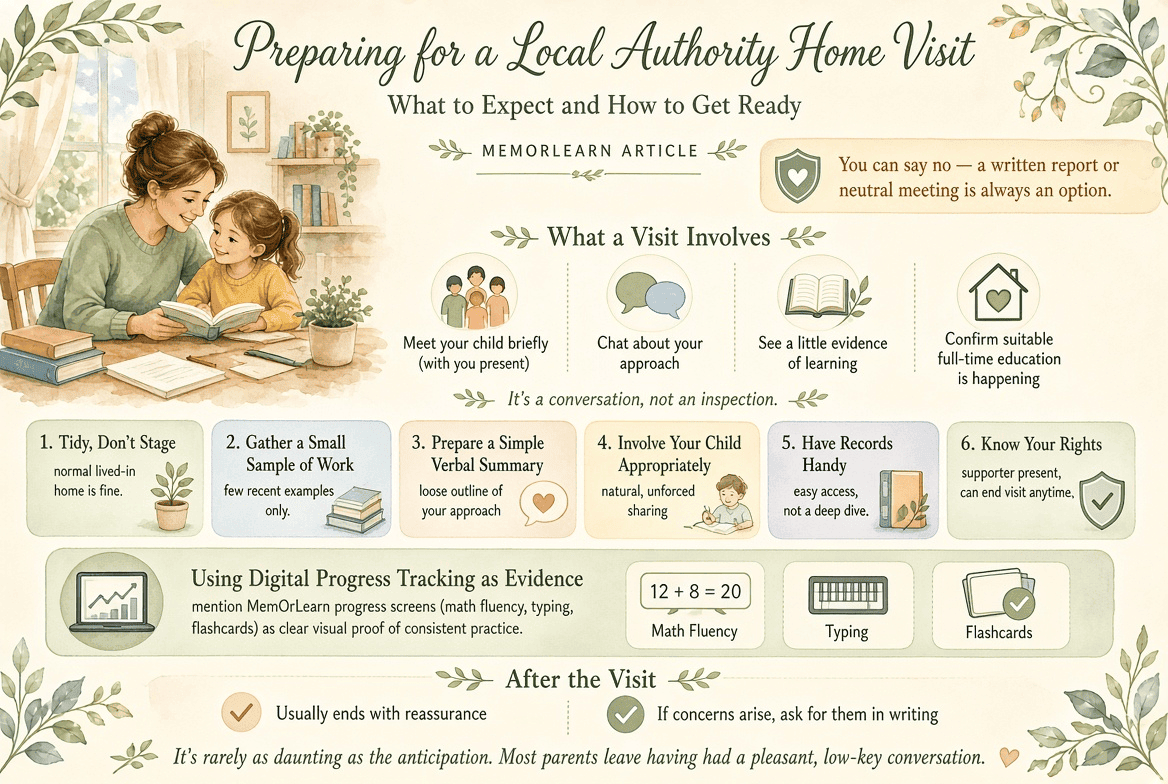
Not every local authority requests a home visit — many are happy with a written report — but if yours has offered or suggested one, it's natural to feel a bit of nervous energy beforehand. The good news is that a home visit is generally a low-key, conversational affair, and a little preparation goes a long way toward making it feel that way in practice too.
Know That You Can Say "No"
Before anything else: you're not legally obliged to accept a home visit. You can offer a written report instead, or ask to meet at a neutral location like a library or café if you'd prefer not to have an officer in your home. If you do agree to a visit, it's because it works for you, not because it's the only option — worth remembering if the whole idea feels uncomfortable.
What a Visit Actually Involves
Most home education visits are informal conversations rather than inspections. A local authority officer will typically want to:
- Meet your child briefly (though they can't insist on speaking to your child alone, or without you present)
- Talk with you about your general approach and what's been covered recently
- See some evidence of learning — this could be workbooks, projects, photos, or simply your description of a typical week
- Get a general sense that a suitable, full-time education is taking place
It's a conversation, not an exam. There's no pass/fail mark, and officers are generally looking for reassurance rather than perfection.
Step 1: Tidy, Don't Stage
You don't need to transform your home into a showroom. A general tidy of the space where learning happens is sensible, but there's no need to hide the ordinary mess of family life, or pretend your home looks like a school every day. A relaxed, lived-in space is a perfectly normal thing for an officer to see.
Step 2: Gather a Small Sample of Work
Pull together a modest selection of recent work — a few completed workbook pages, a project photo, a piece of writing, screenshots of progress from any apps or platforms you use. You're not building an exhibition; a handful of representative examples across two or three subjects is plenty.
Step 3: Prepare a Simple Verbal Summary
Think through, in advance, a short verbal version of what you'd put in a written report: a general sense of your approach, what's been covered recently, and anything you're particularly pleased with or currently working on. Having this loosely rehearsed in your head (not word-for-word, just the shape of it) makes it much easier to speak confidently on the day rather than feeling put on the spot.
Step 4: Involve Your Child Appropriately
If your child is comfortable with it, a brief chat where they can show or talk about something they've been working on tends to go down well — children often speak with more genuine enthusiasm about their own projects than any parent's description could convey. There's no obligation to prep your child extensively; a natural, unforced moment is more convincing than anything rehearsed.
Step 5: Have Records Handy, Not Hidden Away
If you keep any form of ongoing records — even loose termly notes — have them accessible rather than needing to dig through folders mid-conversation. This is one area where a bit of preparation beforehand (pulling together the last few months into one simple summary) makes the actual visit noticeably smoother.
Step 6: Know Your Rights During the Visit
You're entitled to have a friend or supporter present, to decline to answer questions you find intrusive, and to end the visit if you feel uncomfortable at any point. Most visits are entirely amicable, but knowing these boundaries beforehand tends to reduce anxiety about the whole process, even if you never need to use them.
Using Digital Progress Tracking as Evidence
One of the easier things to show during a visit is progress data from any structured tools you use for core skills. If your child uses something like MemOrLearn for maths fluency, typing, or flashcard-based revision, the built-in progress tracking gives you a concrete, visual way to demonstrate consistent practice and improvement over time — often more compelling in the moment than trying to describe progress verbally.
Even families who take a largely autonomous approach elsewhere often find it reassuring to have at least one area with this kind of clear, trackable evidence on hand for exactly this sort of conversation.
After the Visit
Most visits end with the officer confirming they're satisfied, sometimes with light suggestions rather than any formal follow-up. If anything is flagged as a concern, you're entitled to ask for it in writing and to respond in your own time, rather than feeling pressured to resolve everything on the spot.
It's Rarely as Daunting as the Anticipation
The lead-up to a first home visit is almost always more stressful than the visit itself. Most parents come away having had a perfectly pleasant conversation with someone whose actual goal was simply to see that their child is doing well — which, if you're reading this far into a guide about preparing properly, they almost certainly are.