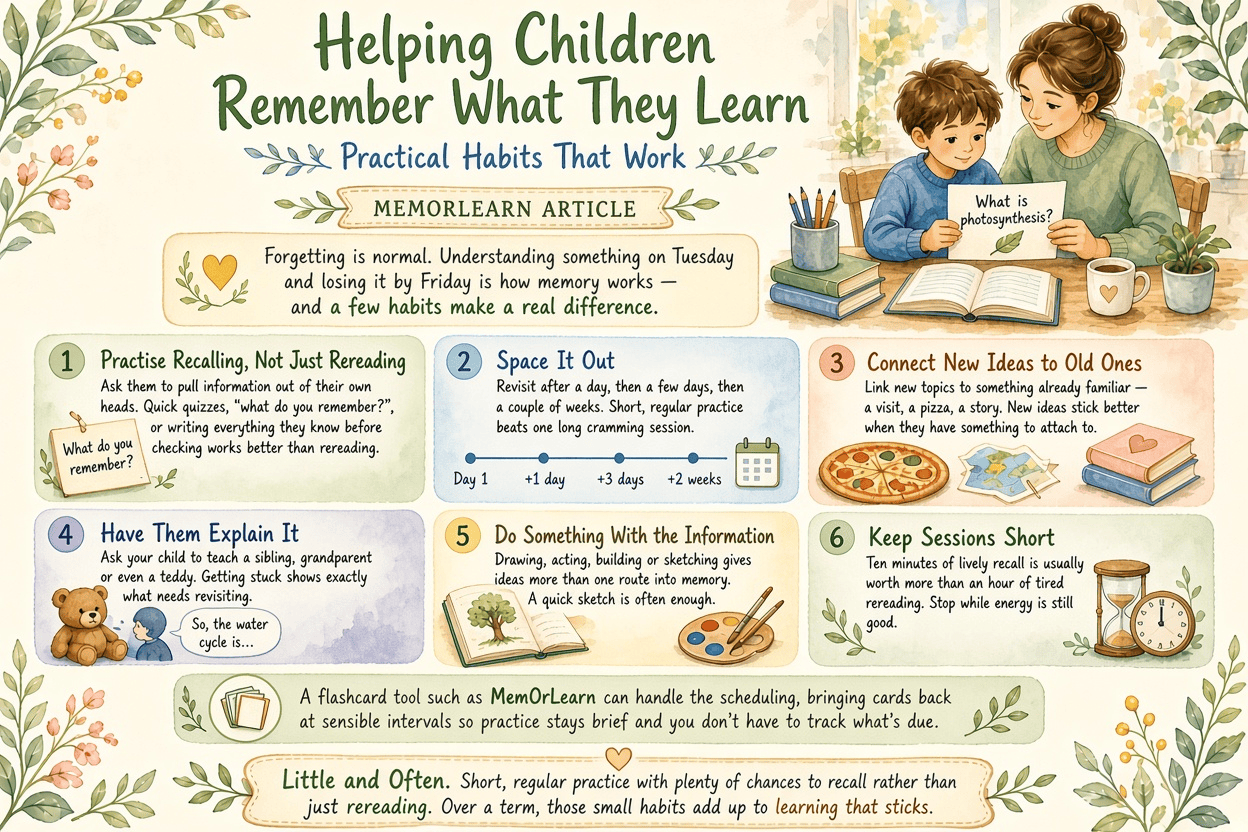
Every home educating parent has had the moment: your child seemed to understand something completely on Tuesday, and by Friday it has vanished. It's frustrating, but it's entirely normal. Forgetting is how memory works, and a few well-established habits can make a real difference to how much stays.
Why Things Get Forgotten
New information fades quickly unless it's revisited. Understanding an idea in the moment is a very different thing from being able to recall it weeks later, and the gap between the two is wider than most of us expect. Knowing this takes some of the sting out of repeated forgetting, and points to what actually helps.
Practise Recalling, Not Just Rereading
Rereading notes or a chapter feels productive, but it mainly builds familiarity rather than real recall. Asking children to pull information out of their own heads is far more effective. Try:
- A quick quiz at the start of the next lesson
- A few questions at the end of a topic
- Asking "what do you remember about yesterday's reading?" before opening the book
- Having them write down everything they know about a topic before checking
Getting something wrong and then seeing the right answer often leads to better learning than getting it right first time, so mistakes here are useful rather than a problem.
Space It Out
Revisiting something after a day, then a few days, then a couple of weeks, works much better than cramming it into one long session. This is why short, regular practice beats a big weekly push. Flashcards are a natural fit, because they let you revisit small pieces of information repeatedly over time. A flashcard tool such as MemOrLearn can handle the scheduling for you, bringing cards back at sensible intervals, so the practice stays brief and you don't have to track what's due.
Protect Sleep
Much of the consolidation of new learning happens overnight, so sleep is part of studying. Squeezing in extra revision late in the evening at the expense of a good night's rest often backfires, especially for older children preparing for exams such as GCSEs.
Connect New Ideas to Old Ones
Children remember best when new information links to something they already know. Before starting a new topic, ask what they already know about it, or what it reminds them of. Linking the Tudors to a castle you've visited, or fractions to sharing a pizza, gives new ideas something to attach to.
Have Them Explain It
Explaining something in your own words is one of the quickest ways to find out whether you really understand it. Ask your child to teach a younger sibling, a grandparent, or even a teddy how something works. If they get stuck partway through, you've found exactly what to revisit.
Do Something With the Information
Children often remember what they've actively done more readily than what they've only read. Drawing a diagram, acting out a historical event, building a model or making a poster all give ideas more than one route into memory. It doesn't need to be elaborate; a quick sketch at the end of a lesson is enough.
Keep Sessions Short
Short, focused sessions generally work better than long ones, particularly for younger children. Ten minutes of lively recall practice tends to be worth more than an hour of tired rereading. If concentration is slipping, a break or a change of activity usually achieves more than pushing on.
Keep Track of What's Secure
With so many things being revisited at different intervals, it's useful to know which ideas are firmly in place and which are still wobbly. A simple notebook works, and so does a platform such as MemOrLearn that records which cards and facts your child is getting right, so you can focus attention where it's needed rather than guessing.
Little and Often
The principle running through all of this is simple: short, regular practice, with plenty of chances to recall rather than just reread. It doesn't need expensive resources or extra hours in the day, only a little consistency. Over a term, those small habits add up to learning that sticks.