One of the first things new home educating parents in the UK bump into is a wall of unfamiliar terminology — Key Stage 2, Key Stage 3, SATs, the National Curriculum. If you've come from a school background yourself, some of this might feel familiar. If not, it can feel like learning a second language just to work out what your child is "supposed" to be doing at their age.
The good news is that none of this is compulsory for home educating families. But understanding how it works is still useful — partly to reassure yourself your child is progressing well, and partly because it gives you a shared reference point when talking to local authorities, exam centres, or even grandparents who keep asking what year group your child is "in."
What the National Curriculum Actually Is
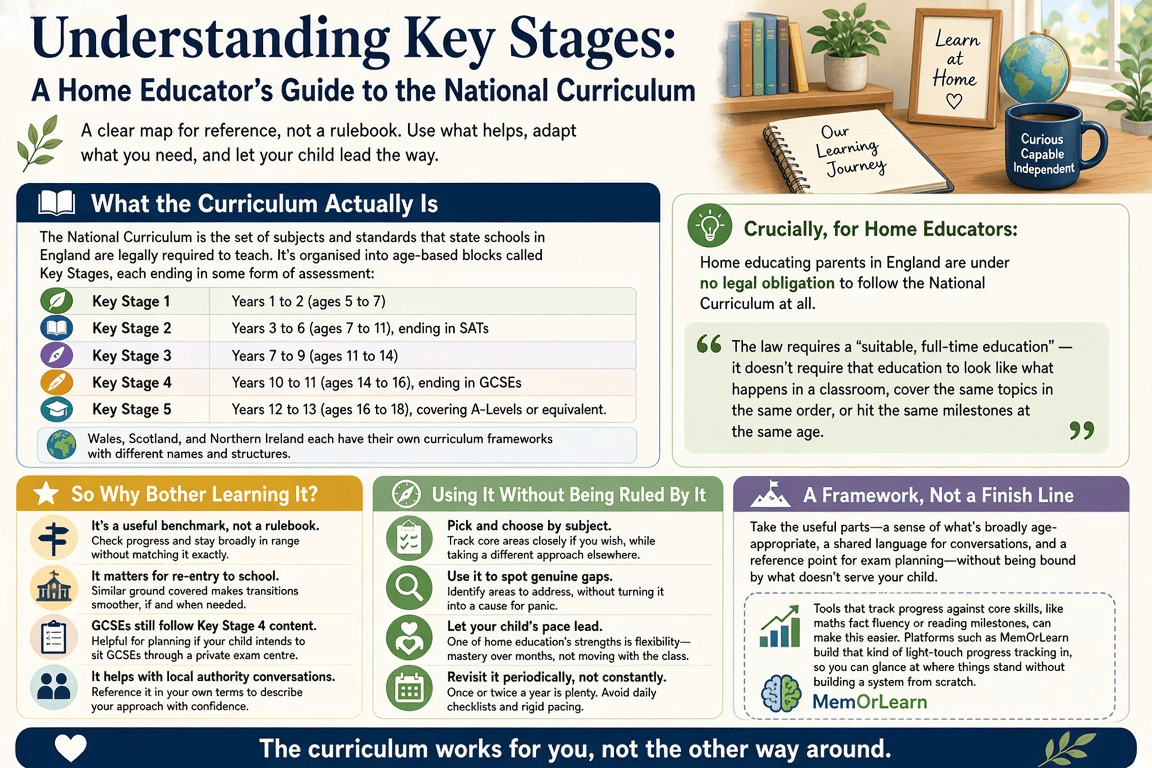
The National Curriculum is the set of subjects and standards that state schools in England are legally required to teach. It's organised into age-based blocks called Key Stages, each ending in some form of assessment:
- Key Stage 1 — Years 1 to 2 (ages 5 to 7)
- Key Stage 2 — Years 3 to 6 (ages 7 to 11), ending in SATs
- Key Stage 3 — Years 7 to 9 (ages 11 to 14)
- Key Stage 4 — Years 10 to 11 (ages 14 to 16), ending in GCSEs
- Key Stage 5 — Years 12 to 13 (ages 16 to 18), covering A-Levels or equivalent
Wales, Scotland, and Northern Ireland each have their own curriculum frameworks with different names and structures, so if you're outside England, the Key Stage system above won't map onto your local terminology directly — Scotland's Curriculum for Excellence, for example, uses entirely different stages and levels.
Crucially, home educating parents in England are under no legal obligation to follow the National Curriculum at all. The law requires a "suitable, full-time education" — it doesn't require that education to look like what happens in a classroom, cover the same topics in the same order, or hit the same milestones at the same age.
So Why Bother Learning It?
If you're not required to follow it, why does the National Curriculum matter to a home educating family? A few practical reasons:
It's a useful benchmark, not a rulebook. Knowing roughly what a Year 4 child is expected to cover in maths, for instance, can help you sanity-check your own child's progress — not because you need to match it exactly, but because it's reassuring to know whether you're broadly in the right range.
It matters for re-entry to school. If there's a chance your child might return to mainstream school later — whether that's planned or just kept as an option — having covered broadly similar ground to their peers makes that transition considerably smoother.
GCSEs still follow Key Stage 4 content. If your child intends to sit GCSEs (through a private exam centre, since home educated students aren't automatically entered), the exam boards' specifications are built around Key Stage 3 and 4 expectations, so some awareness of the structure is genuinely useful for planning ahead.
It helps with local authority conversations. Some local authorities ask home educating parents to describe their approach. You're never obliged to align with the National Curriculum specifically, but being able to reference it in your own terms ("we cover similar ground to Key Stage 2 maths, but at our own pace") can make those conversations more straightforward.
Using It Without Being Ruled By It
The families who get the most value from the National Curriculum tend to treat it as a loose map rather than a fixed itinerary. A few practical approaches:
Pick and choose by subject. You might want to track maths and English fairly closely against Key Stage expectations, while taking a completely different, more exploratory approach to science, history, or the arts.
Use it to spot genuine gaps. If your child is significantly behind expected ranges in a core skill like reading fluency or number sense, that's worth knowing — not to panic about, but to address directly.
Let your child's pace lead. One of the real advantages of home education is that a child who's ahead in one area and behind in another doesn't need to sit through material they've already mastered, or struggle silently through material that's moving too fast. The Key Stage boundaries are built for a classroom of thirty children moving together — your family doesn't need to move that way.
Revisit it periodically, not constantly. Checking in against Key Stage expectations once or twice a year is usually plenty. Treating it as a daily checklist tends to recreate exactly the rigid, one-size-fits-all structure many families choose home education to move away from.
A Framework, Not a Finish Line
The National Curriculum and its Key Stages exist to give large groups of children in institutional settings a shared, trackable structure. As a home educating parent, you get to take the useful parts — a sense of what's broadly age-appropriate, a shared language for conversations with others, a reference point for exam planning later on — without being bound by the parts that don't serve your child.
Tools that track progress against core skills, like maths fact fluency or reading milestones, can make it easier to keep a loose eye on this without turning it into a formal audit — platforms such as MemOrLearn build that kind of light-touch progress tracking in, so you can glance at where things stand without having to build a tracking system from scratch. But whatever tools you use, the underlying principle stays the same: the curriculum works for you, not the other way around.