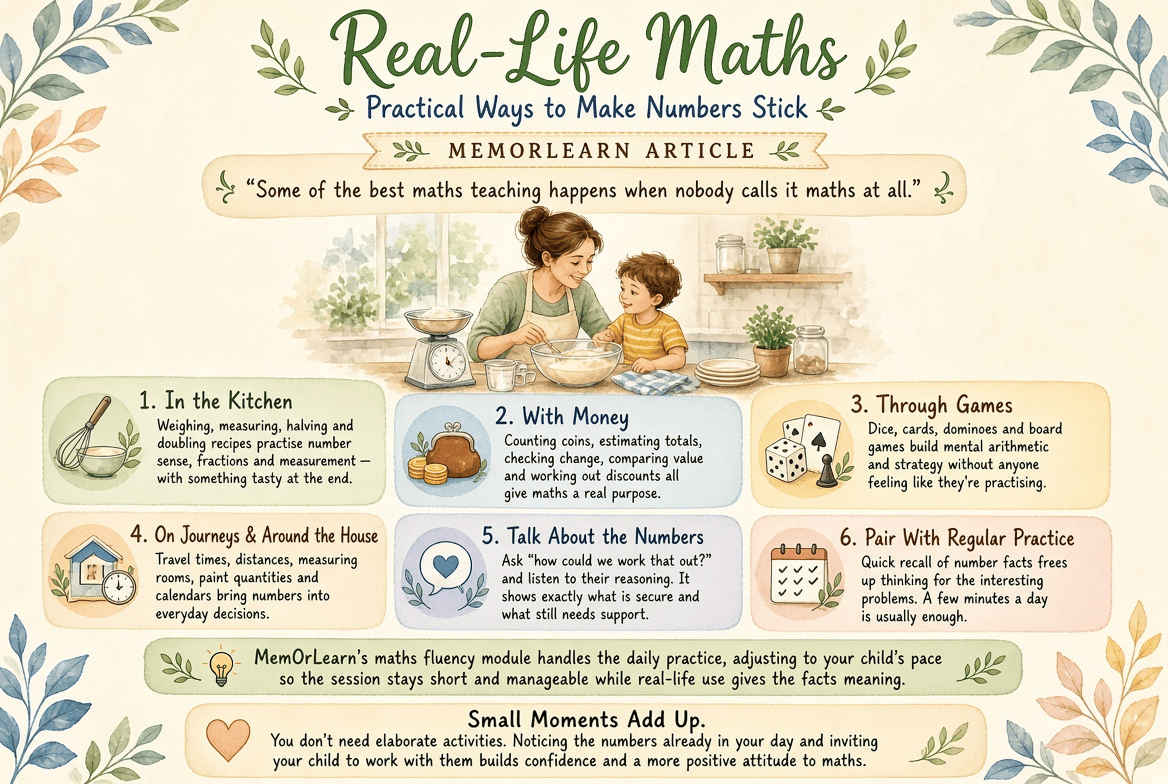
Some of the best maths teaching in a home education household happens when nobody calls it maths at all. A child who weighs out flour for a cake, checks whether they have enough pocket money for a book, or works out how long until the bus leaves is using exactly the skills a workbook is trying to teach, only with a reason attached. Here are practical ways to use that, and how to combine it with a little regular practice.
Why Real-Life Maths Works
Children who can see why numbers are useful tend to engage with them far more willingly. Everyday maths gives each skill a context, which helps ideas stick. It also shows children that maths isn't just something done at a table with a pencil, which can be a real relief for those who've decided they don't like it.
In the Kitchen
Cooking and baking are among the richest sources of practical maths. Weighing ingredients in grams, measuring liquids in millilitres, halving or doubling a recipe and working out cooking times all practise number sense, fractions and measurement, and there's something tasty at the end. Ask children to convert between units, or to work out how much of each ingredient you'd need to feed twice as many people.
With Money
Money is endlessly useful for maths. Younger children can sort and count coins, while older ones can:
- Estimate the total of a shopping basket before you reach the till
- Check the change in pounds and pence
- Compare prices per 100 grams to find the best value
- Work out the sale price after a percentage discount
- Budget a small amount of pocket money across a few weeks
Through Games
Dice games, cards, dominoes and board games build mental arithmetic and strategy without anyone feeling like they're practising. Children will repeat calculations dozens of times when there's something to win. Games such as Monopoly add money handling, while card games like cribbage or simple pairs-to-ten games build quick addition.
On Journeys and Around the House
Journeys give maths a real setting. Working out how long a trip will take, how many miles are left, or what time you'll arrive all involve calculation. Around the house, measuring a room, working out how much paint or carpet you need, reading a timetable or planning the week's activities on a calendar all bring numbers into everyday life.
Talk About the Numbers
The most effective habit is simply to talk about maths aloud as you go. Rather than handing over the answer, ask "how do you think we could work that out?" and let children explain their thinking. Listening to a child's reasoning often shows exactly where an idea is secure and where it's wobbly, which is more useful than a page of marked sums.
Pair It With Some Regular Practice
Everyday maths works best alongside regular practice of the basics. Quick recall of number facts frees up a child's thinking for the more interesting problems, because they aren't using up effort working out 7 × 8 while also trying to scale a recipe. A few minutes a day is usually plenty, and a tool such as MemOrLearn's maths fluency module can handle the practice, adjusting to your child's pace so the daily session stays short and manageable. Real-life use gives the facts meaning, and fluent facts make real-life problems easier.
Keep an Eye on Progress
It can be hard to tell how much children are absorbing from informal maths, because there's no marked worksheet to show for it. Jotting down a few notes each week about what they've worked out in the kitchen or the shop, together with progress records from something like MemOrLearn, gives you a clear picture over time without turning everyday life into a series of tests.
Small Moments Add Up
You don't need to plan elaborate maths activities. Noticing the numbers already in your day and inviting your child to work with them is usually enough. Over a term, those small moments build confidence, understanding and a more positive attitude to maths, which is worth far more than any single worksheet.