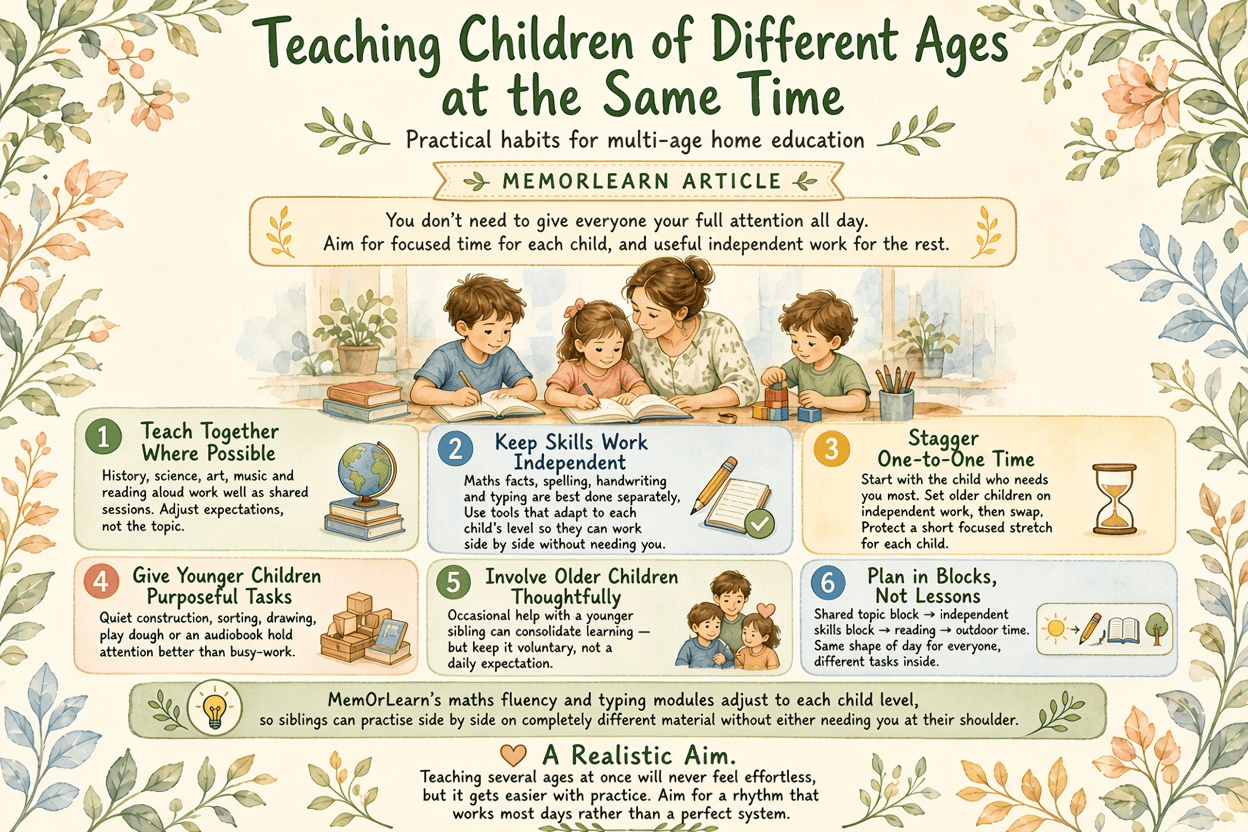
Ask a home educating parent with more than one child what makes the day hardest, and the answer is rarely the subject matter. It's usually the simple arithmetic of being one adult with two, three or four learners, all of whom need something different at exactly the same moment. The six-year-old wants help sounding out a word, the ten-year-old is stuck on a fraction, and the toddler has found the felt tips.
There's no way to make that arithmetic disappear, but a handful of practical habits make it far more manageable.
Let Go of Giving Everyone Your Full Attention
The first adjustment is a mental one. In a school classroom, a teacher also divides their attention between many children, and nobody expects each child to have constant one-to-one time. At home, parents often hold themselves to a higher standard than that, and feel they're failing whenever one child has to wait.
A realistic goal is not "everyone gets my full attention all day" but "everyone gets some focused time each day, and has something useful to do the rest of the time." That's an achievable target, and it's a very different one.
Teach Together Wherever the Subject Allows
Some subjects don't need separating by age at all. History, geography, science, art, music and reading aloud all work well with the whole family together, with expectations adjusted rather than the material changed.
For example, after a shared session on the Romans:
- A five-year-old might draw a Roman soldier and tell you what he's holding.
- An eight-year-old might write a few sentences about daily life in a Roman town.
- A twelve-year-old might research how the army was organised and present it to the others.
Everyone has covered the same topic, you've only planned it once, and each child has worked at their own level. Topic work like this is one of the biggest time-savers in a multi-age household.
Keep Skills Work Separate and Independent
Skills that build step by step, such as number facts, spelling, handwriting and typing, are harder to teach together because each child is at a different point. These are best handled as short, independent blocks, where each child works at their own level while you're free to sit with someone else.
The key is making that independent work genuinely independent. A task that needs you to explain it, supervise it and mark it doesn't free you up at all. Workbooks with clear instructions, reading books at the right level, and tools that give each child the right material and handle the marking themselves all help here. MemOrLearn's maths fluency and typing modules, for instance, adjust to each child's own level, so two siblings can practise side by side on completely different material without either needing you at their shoulder.
Stagger Your One-to-One Time
Rather than trying to hover between children, many parents find it works better to plan the order of the morning deliberately:
- Start with whoever needs you most. For many families that's the youngest, who has the shortest concentration span and is often at their best early in the day.
- Set the older children off on independent work while you sit with the little ones, then swap.
- Plan one short, protected stretch of time with each child, even if it's only fifteen or twenty minutes, so nobody goes a whole day without your focused attention.
Writing down the rough order, even just on a scrap of paper, removes the constant mental juggling of who to help next.
Give Younger Children Something Purposeful to Do
"Keep the little one busy" is easier said than done, and busy-work rarely holds a child's interest for long. Younger children tend to stay occupied for longer with something that feels real: building with construction toys, sorting and counting objects, drawing or painting, play dough, simple baking, or listening to an audiobook. A small basket of quiet activities kept aside for lesson time, and rotated now and then so it stays fresh, can buy you surprisingly long stretches.
Involve Older Children Thoughtfully
Older children can be a real help with younger ones, whether that's reading them a story, explaining a game, or helping with a craft. Teaching something to a younger sibling is also a good way for an older child to consolidate what they know.
It works best as an occasional, voluntary arrangement rather than a standing expectation. An older child who becomes an unpaid teaching assistant every day can quickly feel resentful, and their own learning can quietly suffer as a result.
Plan the Week in Blocks, Not Lessons
Trying to plan separate, timed lessons for each child tends to collapse under the weight of the logistics. Many multi-age families find it much easier to plan in blocks: a shared block for topic work, a block for independent skills, a block for reading, and a block for outdoor time or practical activities. Each child's tasks inside the block differ, but the shape of the day stays the same for everybody, which makes it far easier to run.
Expect Different Paces, and Resist Comparing
Sooner or later, one child will race ahead in something a sibling finds hard, or the youngest will pick up a skill years earlier than the eldest did. That's entirely normal. Comparing siblings, even privately, tends to create pressure that doesn't help anyone. It's much easier to keep track of each child's own progress, in their own terms, than against a brother or sister. Tools that record progress for each child separately take some of that tracking off your plate, so you don't have to keep everything in your head.
A Realistic Aim
Teaching several ages at once will never feel effortless, but it does tend to get easier with practice. As routines settle, children get better at working independently, and the older ones' patience and the younger ones' stamina both grow. Aim for a rhythm that works most days rather than a perfect system, and expect to adjust it each term as the children change.