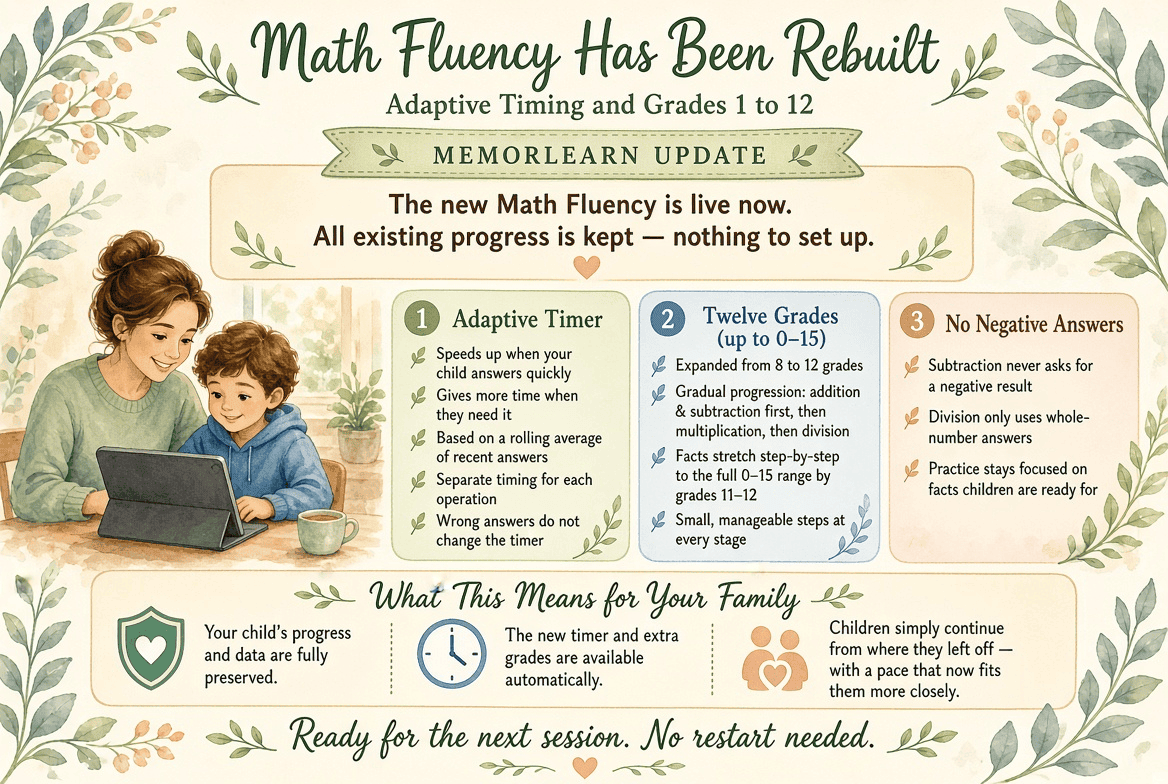
We've completely redone the Math Fluency module, and the changes are live now. The headline improvements are a timer that adapts to your child's own pace, twelve grades instead of eight, and a rule that means your child is never asked for a negative answer.
Everything your child has already built up has been kept, and the new features are available to every account automatically. There's nothing for you to set up or switch on.
A Timer That Adapts to Your Child
Previously, every child in a given grade worked against the same fixed timer. That works well for some children and feels either rushed or far too relaxed for others. The new timer adjusts itself to how your child actually answers.
- Answer faster, and the timer gets faster. As your child becomes quicker at a fact family, the time allowed for each sum tightens to keep the practice challenging.
- Answer more slowly, and the timer gives them more room. If a child is still working things out, the timer relaxes so they aren't hit with a clock they can't realistically beat.
The timer is based on a rolling average of your child's recent answers, and it's recalculated with every sum, so it's always responding to how they're doing right now rather than how they did last week.
Wrong answers don't change the timer. A mistake won't make the clock harsher or more lenient, so one slip never distorts the pace your child has settled into.
The timer is also kept separately for each operation. A child who is quick at addition but still building confidence with subtraction gets timing that suits each one. It resets when your child moves to a different operation, and again when they change grade, which gives them a fresh start on new material.
Limits on the Timer
The adaptive timer has a fastest and a slowest limit, so it can never become unreasonably quick or drag on indefinitely. These limits are site-wide defaults, and neither parents nor children can adjust them. That keeps the experience consistent from family to family.
The limits also change with the grade. Grade 1 starts at a gentle pace, and the timing gets quicker through to grade 7. By grade 12 it eases off again, because the facts are larger and simply need more thinking time.
Twelve Grades, Up to Facts of 0 to 15
Math Fluency previously had eight grades. It now has twelve, extending the practice well beyond the old limit. Here's what each grade covers:
| Grade | Addition | Subtraction | Multiplication | Division |
|---|---|---|---|---|
| 1 | 0-3 | 0-3 | - | - |
| 2 | 0-5 | 0-5 | - | - |
| 3 | 0-7 | 0-7 | 0-2 | - |
| 4 | 0-8 | 0-8 | 0-4 | - |
| 5 | 0-10 | 0-10 | 0-5 | - |
| 6 | 0-10 | 0-10 | 0-10 | - |
| 7 | 0-12 | 0-12 | 0-12 | 0-8 |
| 8 | 0-12 | 0-12 | 0-12 | 0-10 |
| 9 | 0-13 | 0-13 | 0-13 | 0-12 |
| 10 | 0-14 | 0-14 | 0-14 | 0-14 |
| 11 | 0-15 | 0-15 | 0-15 | 0-15 |
| 12 | 0-15 | 0-15 | 0-15 | 0-15 |
The progression is deliberately gradual:
- Grades 1 and 2 focus on addition and subtraction only, with facts up to 3 and then up to 5.
- Multiplication arrives in grade 3, starting very small at 0 to 2, then 0 to 4 in grade 4, 0 to 5 in grade 5 and 0 to 10 in grade 6, reaching 0 to 12 by grade 7.
- Division joins in grade 7, once multiplication is established, starting at 0 to 8, then 0 to 10 in grade 8 and 0 to 12 in grade 9.
- Grades 9 to 12 stretch all four operations step by step, reaching the full 0 to 15 range across addition, subtraction, multiplication and division in grades 11 and 12.
Each step up is small, so your child is never asked to leap from a comfortable range into a much bigger one.
Your Child Will Never Be Asked for a Negative Answer
We've added a rule to the system so that every fact your child practises can be answered with a whole, non-negative number.
- In subtraction, a sum that would give a negative answer, such as 2 − 4, is simply removed from the practice grid and never asked.
- In division, only whole-number answers are used.
This keeps practice focused on the facts children at these stages are expected to know, without confusing them with answers they haven't yet been taught how to give.
What This Means for Your Family
Your child's existing progress and data are fully preserved, and the new timer and the extra grades are available immediately and automatically. Children carry on from where they were, with no need to restart anything.
If your child has already been working near the top of the old eight grades, they now have somewhere to go next. If they're earlier in their journey, the adaptive timer means the pace of practice will start fitting them more closely from their very next session.