If your local authority has asked for an annual update on your child's home education, it's easy to feel a flicker of exam-style dread — as though you're about to be marked. In reality, most LAs simply want reassurance that a suitable, full-time education is taking place, and a clear, well-organised report usually does that job in far less time than people expect.
Here's a straightforward way to put one together.
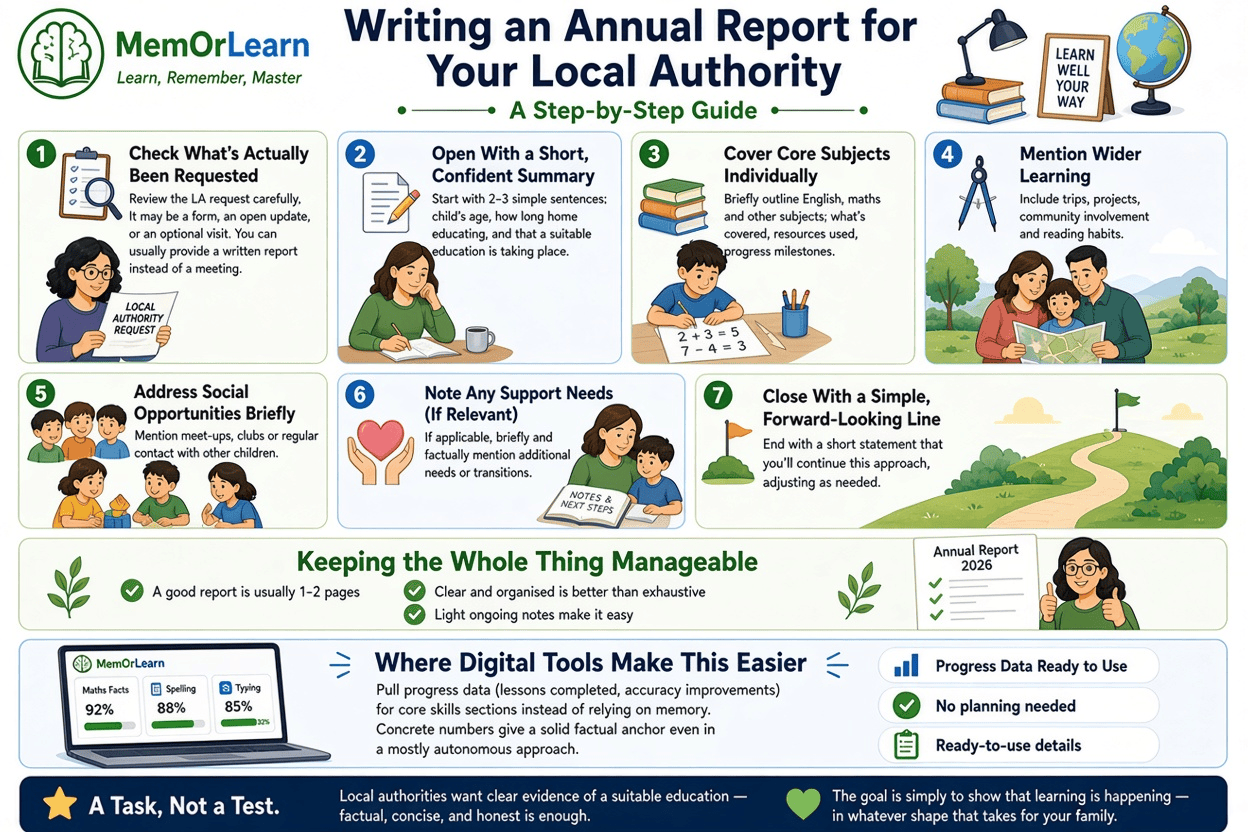
Step 1: Check What's Actually Been Requested
Not every local authority asks for the same thing. Some send a specific form with set questions; others simply ask for "an update on your child's education" and leave the format entirely up to you. Before writing anything, check exactly what's been requested — a written report, a meeting, or a choice between the two. You're generally entitled to decline a home visit and provide information in writing instead, so don't assume a visit is the only option if one's been suggested.
Step 2: Open With a Short, Confident Summary
Start with two or three sentences giving an overview: your child's age, roughly how long they've been home educated, and a general statement that a broad, suitable education is being provided across core and wider subjects. This sets a calm, matter-of-fact tone for everything that follows.
Step 3: Cover Core Subjects Individually
Break the report into short sections by subject — typically English, maths, and then whatever else has featured over the year (science, art, PE, and so on). For each one, briefly note:
- What's been covered or focused on
- What resources, curricula, or tools were used
- Any progress worth mentioning (a milestone, a leap in confidence, a specific achievement)
This doesn't need to be exhaustive. A few sentences per subject is normal, and honest, general descriptions ("developed growing confidence with multiplication and division, using a mix of workbooks and daily practice on a maths app") are perfectly acceptable — you're not writing a school-style curriculum breakdown.
Step 4: Mention Wider Learning, Not Just "Subjects"
Local authorities generally respond well to evidence that education is happening beyond a desk. A short paragraph mentioning trips, group activities, community involvement, reading habits, or projects rounds out the picture and reflects how home education actually works day to day.
Step 5: Address Social Opportunities Briefly
A short mention of group activities, home education meet-ups, clubs, or regular contact with other children reassures a local authority on the socialisation question without needing to write an essay about it — a sentence or two is usually enough.
Step 6: Note Any Support Needs, If Relevant
If your child has additional needs, or you're navigating anything specific (a diagnosis, a transition, extra support), it's worth mentioning briefly and factually. This isn't required, but it can pre-empt follow-up questions and shows the local authority you're being transparent about the full picture.
Step 7: Close With a Simple, Forward-Looking Line
End with a short closing sentence — something along the lines of continuing the current approach, with adjustments as needed based on your child's progress and interests. There's no need to promise specific plans for the year ahead in detail; a general statement of intent is sufficient.
Keeping the Whole Thing Manageable
A good annual report is usually one to two pages, not a lengthy document. Local authority officers read a great many of these, and a clear, well-organised report is more useful to them (and less stressful for you) than an exhaustive account of every week of the year.
If you've kept even loose termly notes throughout the year, writing this report becomes a matter of pulling those together rather than reconstructing twelve months from memory — which is exactly why many home educating families find some form of light, ongoing record-keeping pays off at report time, even though it's not legally required.
Where Digital Tools Make This Easier
One practical shortcut: where you've used a structured tool for core skills, much of the "what did we cover, and how did they progress" section can be pulled straight from built-in progress data rather than written from scratch. MemOrLearn, for example, tracks a child's progress through maths fluency, typing, and flashcard modules automatically, giving you concrete, specific details (lessons completed, accuracy improvements) to draw on for the maths and core skills sections of a report, rather than relying purely on memory.
Even for families who prefer a mostly autonomous approach elsewhere, having that kind of concrete data for at least one or two core subjects can make an annual report noticeably easier to write, and gives you a solid factual anchor around which to describe everything else.
A Task, Not a Test
An annual report can feel like a bigger deal than it actually is. Local authorities aren't looking for perfection or a school-style curriculum match — they're looking for evidence of a genuine, suitable education, described clearly and honestly. Keep it factual, keep it reasonably concise, and it's a task you'll likely spend less time on each year as the process becomes familiar.