Ask a handful of UK home educating parents how they keep records, and you'll get a handful of different answers — a scrapbook, a spreadsheet, a shoebox of worksheets, or in some cases, nothing written down at all. There's no legally mandated format, which is genuinely freeing, but it also means many families aren't sure where to start, or whether they're doing "enough."
Here's a practical look at what's actually worth recording, why it matters even though it's not compulsory, and how to keep it manageable rather than turning into a second job.
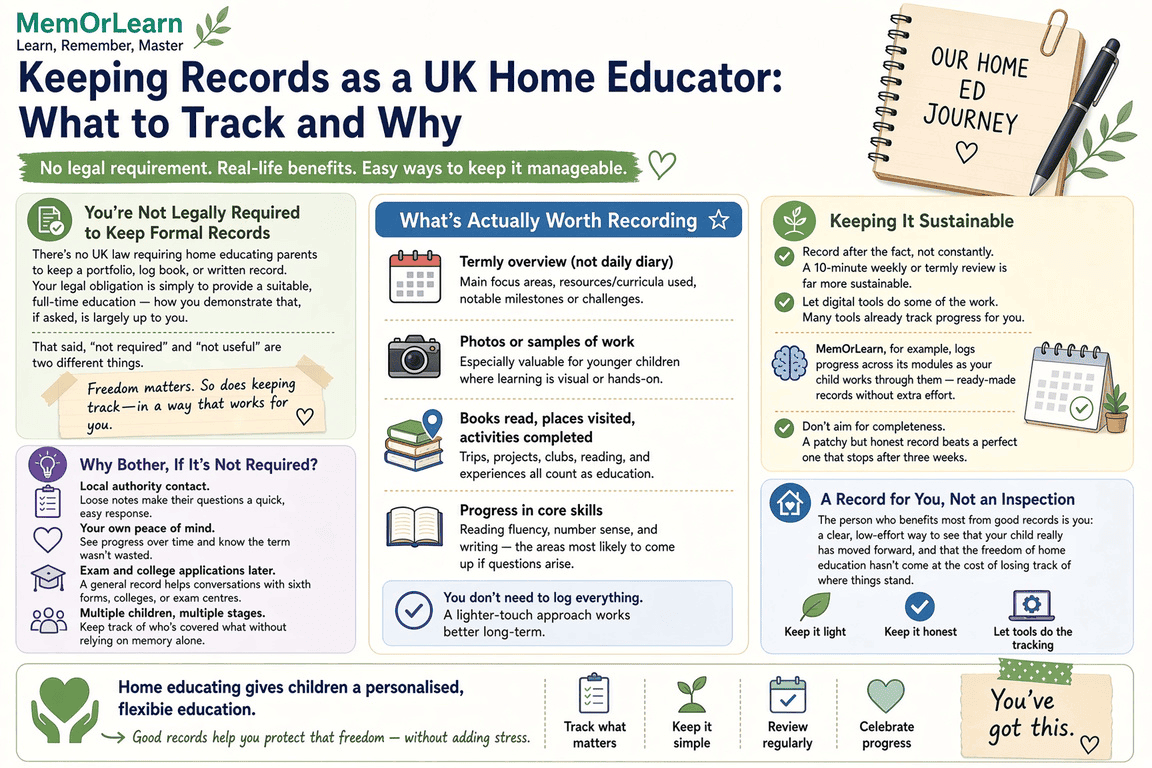
You're Not Legally Required to Keep Formal Records
It's worth saying plainly: there's no UK law requiring home educating parents to keep a portfolio, log book, or written record of what their child has covered. Your legal obligation is simply to provide a suitable, full-time education — how you demonstrate that, if asked, is largely up to you.
That said, "not required" and "not useful" are two different things. Most experienced home educating families keep some form of record anyway, for reasons that have nothing to do with satisfying anyone else.
Why Bother, If It's Not Required?
Local authority contact. Some local authorities ask home educating parents for information about their approach, sometimes annually. Having even loose notes on hand — topics covered, resources used, rough progress — makes this a five-minute task instead of a scramble to reconstruct months of learning from memory.
Your own peace of mind. Home education can feel invisible day to day. A term can pass with genuine progress that's easy to lose track of simply because there's no report card marking it. A simple record gives you something to look back on when you're wondering whether things are actually moving forward.
Exam and college applications later. If your child later applies to a sixth form, college, or as a private candidate for GCSEs, having a general sense of what's been covered — even informally — makes conversations with admissions staff or exam centres considerably smoother.
Multiple children, multiple stages. If you're home educating more than one child at different ages, records help you keep track of who's covered what, without relying purely on memory.
What's Actually Worth Recording
You don't need to log every single day. Most families find a lighter-touch approach works better long-term:
- A termly overview rather than a daily diary — what subjects were the main focus this term, what resources or curricula were used, and any notable milestones or challenges
- Photos or samples of work, especially for younger children where the "output" is often more visual or physical than written
- Books read, places visited, and activities completed — home education often includes trips, projects, and reading that don't fit neatly into subject boxes, but are genuinely educational
- Progress in core skills like reading fluency, number sense, and writing, since these are the areas most likely to come up if a local authority does ask questions
Keeping It Sustainable
The biggest reason record-keeping falls apart isn't lack of interest — it's that an ambitious system (daily logs, detailed subject-by-subject notes) becomes a chore within a few weeks and then quietly stops.
A few things that help it stick:
Record after the fact, not constantly. A ten-minute weekly or termly review is far more sustainable than trying to note things down in real time throughout the day.
Let digital tools do some of the work. Where you're using structured tools for core skills — maths fluency drills, typing practice, spaced-repetition flashcards — many of these already track progress automatically, which takes that piece off your plate entirely. MemOrLearn, for example, logs progress across its modules as your child works through them, so you've got a ready-made record for those subjects without any extra effort on your part.
Don't aim for completeness. A patchy but honest record beats a perfect one that stops after three weeks because it became unmanageable.
A Record for You, Not an Inspection
It's easy to slip into thinking of home education records as something you're building for someone else to check — a local authority, a future exam board, a curious relative. In practice, the person who benefits most from good records is you: a clear, low-effort way to see that the term wasn't wasted, that your child really has moved forward, and that the freedom of home education hasn't come at the cost of losing track of where things stand.
Keep it light, keep it honest, and let the tools you're already using do as much of the tracking as possible.