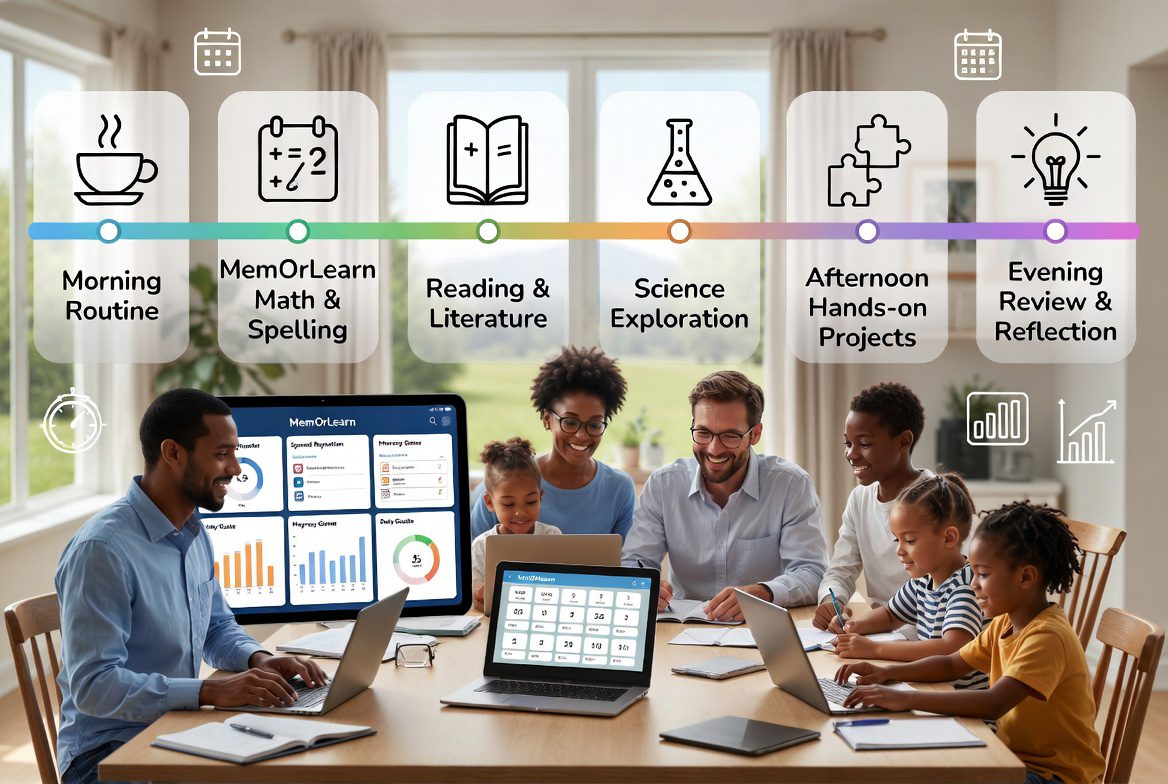
One of the greatest freedoms of homeschooling is also one of its greatest challenges — you get to design the day yourself. There's no bell schedule, no fixed timetable handed down from a school office, and no one telling you when maths happens or how long reading should take. That freedom is genuinely wonderful. It's also, on a Tuesday morning when nobody wants to do anything, genuinely overwhelming.
Structure matters in homeschooling. Not rigid, military-style scheduling where every minute is accounted for, but a reliable rhythm that children can anticipate and parents can actually deliver consistently. Digital tools, used well, can be a significant help — not because screens are better than books, but because the right platform removes friction, tracks progress automatically, and gives children a sense of ownership over their own learning.
Here's how to think about building a homeschool day that works, and where digital tools fit naturally within it.
Start With Your Non-Negotiables
Before you open any app or platform, start on paper. Write down the subjects and skills your child needs to cover each week. For most homeschool families this will include some combination of maths, English, reading, writing, and depending on your approach, Bible study, science, history, and a foreign language.
Once you know what needs to happen, you can start thinking about when. Most educational research points to the same conclusion — cognitively demanding work is best done in the morning when focus is sharpest. Save lighter or more enjoyable tasks for the afternoon when energy naturally dips.
A simple weekly non-negotiable list might look like this:
- Daily: maths practice, reading, typing, Bible memory
- Three times a week: grammar, writing, science
- Once a week: history, art, nature study
That list becomes the skeleton of your week. Everything else hangs off it.
Morning: Lead With the Hard Stuff
Start the school day with the subjects that require the most mental effort. For most children this means maths and language work — the things that need full concentration and can't be powered through on autopilot.
A practical morning block for a primary or middle school student might look like:
8:30 — Morning Startup
Begin with something short and achievable to ease into the day. A typing session works brilliantly here. It's focused, it has a clear start and end point, and it builds a genuinely valuable skill without feeling like heavy academic work. MemOrLearn's Typing Tutor offers 125 progressive lessons that take students from basic home-row positioning through to confident touch typing — ten to fifteen minutes a day compounds remarkably quickly over a school year.
9:00 — Core Maths
Move into your primary maths curriculum while focus is at its peak. After the main lesson or worksheet, a short session of math fluency drills reinforces the foundational facts that underpin everything else. MemOrLearn's Math Fluency module tracks individual facts, identifies weak areas, and automatically prioritises the questions a student needs most. Five to ten minutes of adaptive drilling after a maths lesson is far more effective than another worksheet.
10:00 — Reading and Language
Reading aloud, independent reading, or phonics work depending on your child's age and stage. Follow this with grammar if it's on your schedule for the day. Digital grammar tools that teach through real sentences and stories — rather than abstract rule memorisation — tend to hold attention better and produce faster results.
10:45 — Break
A proper break. Outside if possible. Movement matters enormously for learning retention, and a child who has had fresh air and physical activity after a morning of focused work will engage far better in the afternoon than one who has sat at a table for three hours straight.
Midday: Bible Memory and Lighter Work
After lunch is often the most underestimated part of the homeschool day. Energy is lower, motivation tends to dip, and trying to push through heavy academic content in this window frequently leads to frustration on both sides.
This is the ideal time for Bible memory work. It's meaningful, it's engaging, and the repetitive nature of memorisation practice actually suits the post-lunch brain well. MemOrLearn's Bible Memory module walks students through a three-step process — reading and typing verses, gap-fill reinforcement, and finally full recall from memory. Working through one or two verses per day builds an impressive body of scripture knowledge over a school year with very little daily time investment.
This block is also good for flashcard review — revisiting vocabulary, history facts, science terms, or anything from the week's learning. Spaced repetition flashcards are particularly well suited to this time of day because they're broken into short, self-contained bursts rather than requiring sustained deep focus.
Afternoon: Project Work and Creative Subjects
Save the afternoon for subjects that benefit from a different kind of energy — history projects, art, nature journalling, creative writing, science experiments, or co-op classes. These activities tend to be more hands-on and intrinsically motivating, which makes them easier to sustain when the morning's concentration has been spent.
If your child has a progress dashboard they check at the end of the school day, the afternoon is also a natural time to review it. Seeing completed lessons, streaks, and accuracy scores gives children a concrete sense of what they've achieved — something a stack of worksheets doesn't always provide.
Keep It Flexible, Not Fragile
The best homeschool schedules are flexible by design. Life happens — appointments, bad days, unexpected rabbit holes that turn into the best learning of the week. The goal isn't to replicate a school timetable at home. It's to create enough structure that learning happens consistently, even when motivation is low.
Digital tools support that consistency because they remove the planning burden from individual sessions. When a child opens a typing lesson or a math fluency drill, they don't need to be told what to do — the platform guides them through it. That independence builds over time, and a child who can navigate their own learning tools confidently is developing skills that will serve them long after the school day ends.
The rhythm matters more than the schedule. Build the rhythm, and the learning follows.
MemOrLearn supports the full homeschool day — from morning typing practice to afternoon Bible memory. Try it free for 14 days at memorlearn.com no card required.