If you've spent any time researching math curriculum, you've run into the term "math fact fluency." It sounds like jargon, but it describes something every parent has actually watched happen: the difference between a child who has to stop and count on their fingers for 7 + 8, and one who just knows it's 15 without thinking. That instant, effortless recall is math fact fluency, and it may be the single strongest predictor of how comfortable a child feels with maths for years to come.
This guide covers what fluency actually means, why it matters so much more than it seems to, and exactly how to build it at home.
What Math Fact Fluency Actually Means
Math fact fluency is the ability to recall basic arithmetic facts — addition, subtraction, multiplication, and division within a set range — quickly, accurately, and without conscious effort. In practice, that looks like:
- Knowing instantly that 6 × 7 = 42, rather than working it out
- Recalling that 12 − 5 = 7 without counting backward
- Recognising number relationships, like knowing that 8 + 8 = 16 means 8 + 9 must be 17
Educators typically describe fluency as having four parts working together:
- Accuracy – getting the right answer
- Efficiency – getting there without unnecessary steps
- Automaticity – recalling it instantly, without calculating
- Flexibility – applying a fact across different contexts (6 × 7 also unlocks 7 × 6 and 42 ÷ 6)
This is different from simply "knowing how" to add or multiply. A child can understand the concept of multiplication perfectly and still lack fluency if they have to reconstruct 9 × 6 from scratch every time it comes up.
Why Fluency Matters More Than It Seems To
It's tempting to treat fluency as just a speed issue — nice to have, not essential, as long as the child eventually lands on the right answer. But fluency isn't really about speed for its own sake. It's about working memory.
Working memory is the mental scratchpad a child uses to hold information while thinking through a problem, and it's limited. If a child has to spend a chunk of it calculating 7 × 8 in the middle of a long division problem, there's less mental capacity left over to track the actual new steps being learned. Fluent recall frees that capacity up for the harder skill in front of them.
That single mechanism explains most of fluency's downstream effects:
- Slower progress on later topics. Fractions, long division, area and volume, and algebra all assume fast fact recall as a baseline. Without it, every new topic becomes two problems at once — the new concept, and the arithmetic underneath it.
- Lower confidence and rising math anxiety. Kids who feel slow or unsure with "easy" facts often conclude they're just not a math person, well before the material has actually gotten hard.
- Weaker performance under time pressure. Timed tests and in-class activities punish slow recall even when a child's reasoning is completely sound.
- Weaker real-world number sense. Fluent kids estimate better, catch their own errors faster, and handle everyday mental math — tips, measurements, quick totals — with far more ease as they grow older.
- A compounding effect across grade levels. Fluency built with addition and subtraction in first and second grade pays off in third-grade multiplication, which pays off in fourth-grade division, which pays off in fractions. Each stage is easier when the one before it is solid, and harder when it isn't.
The reassuring part: fact fluency is highly trainable. Unlike some academic skills that take years to shift, it responds well to short, frequent, low-stakes practice — often just five to ten minutes a day of the right kind of repetition.
A Few Things Worth Watching For
Fluency drills are not a substitute for conceptual understanding. A child should grasp why 4 × 3 = 12 — through equal groups, arrays, or repeated addition — before or alongside memorising that it does. Drilling a fact a child doesn't yet understand conceptually just produces rote memorisation without real number sense underneath it.
Timed drills can also spike anxiety in kids who are naturally more sensitive to being watched or timed, so it's worth pairing fluency practice with a low-pressure, private setting, at least at first, rather than a public or competitive one.
And fluency needs to be built through spaced review, not crammed. A single intense week of drilling won't stick nearly as well as a few minutes daily over months, since long-term recall depends on facts being revisited just as they start to fade.
How to Build Fluency at Home: What Actually Works
A handful of principles, backed by both research and classroom experience, consistently show up in what works:
- Short, frequent sessions beat long, infrequent ones. Ten focused minutes a day outperforms an hour once a week. The brain needs repeated, spaced exposure to shift a fact from "worked out" to "known."
- Understanding comes before drilling. Confirm conceptual understanding first, then convert it into automatic recall — not the other way around.
- Mixed practice beats blocked practice. Drilling only the 7-times table in isolation feels easier in the moment, but mixing facts from different families forces genuine recall instead of pattern-following.
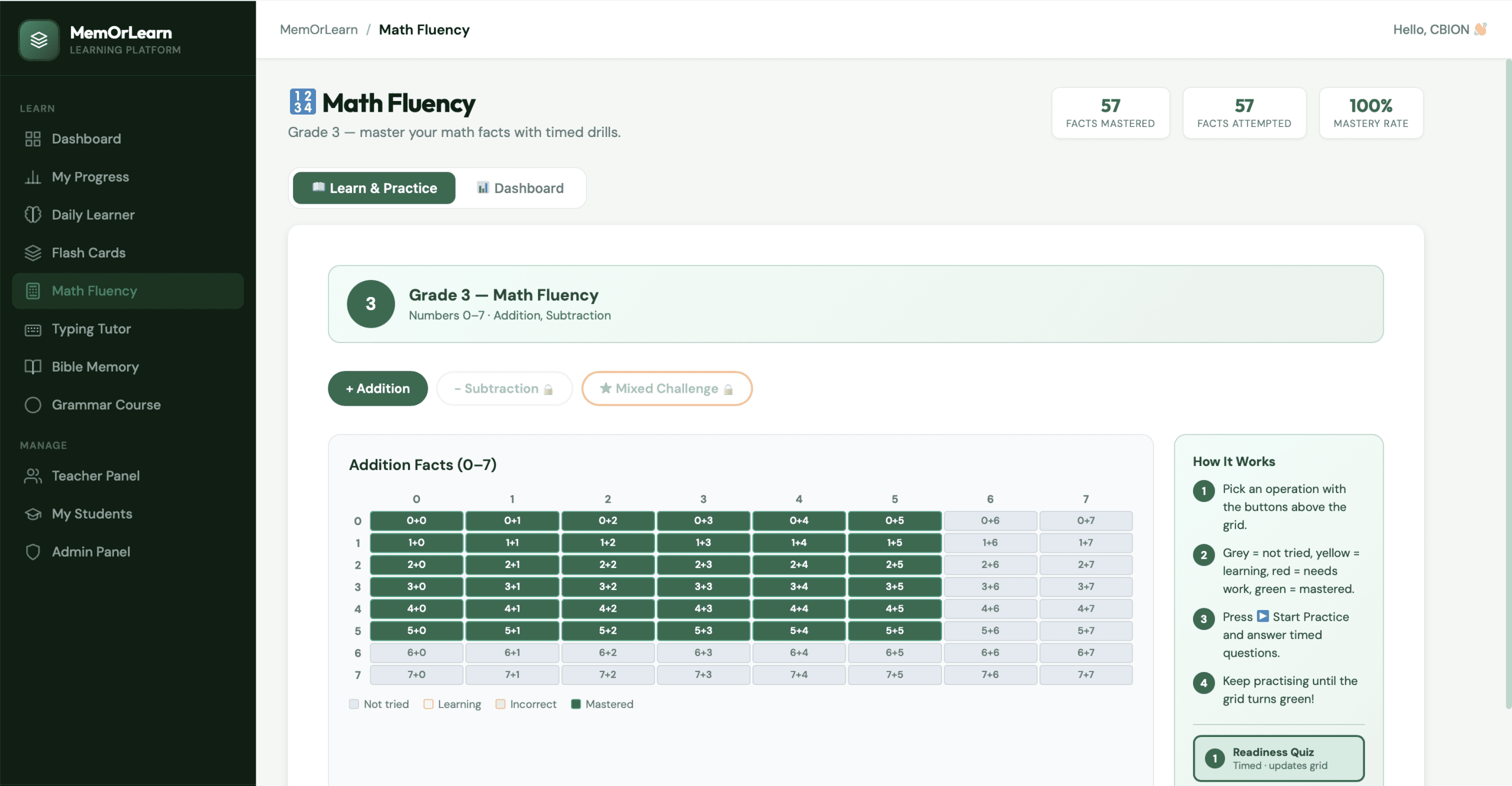
- Track and target weak spots. A generic worksheet treats every fact equally. Identifying exactly which facts a child hasn't yet mastered, and giving those extra repetition, is far more efficient than redoing everything from scratch.
- Keep the pressure low. Frequent, quick, judgment-free practice builds genuine confidence. A once-a-week timed test that determines a grade tends to build anxiety instead.
This is precisely the gap a well-designed digital tool can close: one that mixes facts intelligently, tracks which specific facts a child has and hasn't mastered, and delivers short daily sessions rather than long occasional ones — which is exactly what homeschooling is naturally well-suited to provide, given the flexibility to fit in a few minutes daily rather than a single scheduled classroom block.
MemOrLearn's Math Fluency module is built around exactly this approach — short daily drills that adapt to where each child's specific gaps are, so fluency builds steadily without turning math time into a battle.
Bringing It Together
Math fact fluency is a quiet, foundational skill. It rarely gets celebrated the way solving a tricky word problem does, but it's the thing that makes every later maths topic feel manageable instead of overwhelming. Building it doesn't require more hours of homework — it requires shorter, smarter, more targeted practice, repeated consistently over time.
See our other Math Fluency articles here: What Is Math Fact Fluency (and Why It Matters More Than You Think) - What Is Math Fact Fluency and How Homeschoolers Build It Fast - How to Build Strong Math Fact Fluency: A Step-by-Step Guide for Homeschool Families