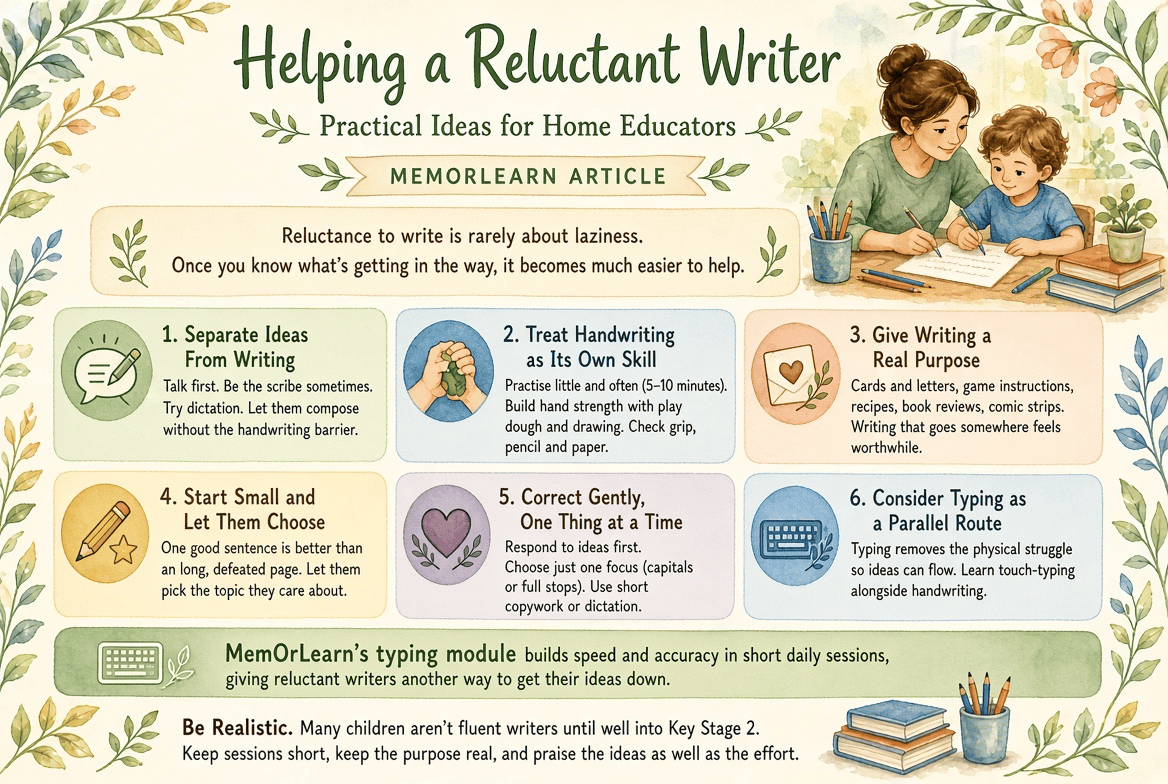
If you've ever watched a child who can talk for an hour about dinosaurs, football or their latest Lego build go silent when handed a pencil, you're in very good company. Reluctance to write is one of the most common challenges in home education, and it's rarely about laziness or lack of ability. Once you know what's making writing hard, it becomes much easier to make it manageable.
Why Writing Feels So Hard
Writing asks a child to do several demanding things at once: come up with an idea, shape it into sentences, remember the spelling, form the letters and keep track of punctuation, all while their hand tires quickly. A child's ideas are often far bigger than their ability to get them onto the page, and that gap is frustrating. So the useful question isn't "why won't they just write?" but "which part is getting in the way?"
Separate the Ideas From the Writing
Try treating composing (having and organising ideas) and transcribing (the physical writing and spelling) as two different jobs.
- Talk first. Many children produce far better ideas out loud than on paper.
- Be the scribe sometimes. Writing down their words lets them practise composing without the handwriting barrier.
- Try dictation. Speaking into a device and seeing the words appear shows a child their ideas are good.
Treat Handwriting as Its Own Skill
Handwriting develops over time, and for many children it's the real bottleneck. Keep it separate from creative writing, and practise little and often: five or ten minutes a day works better than one long session a week. For younger children, build hand strength first with play dough, drawing, cutting and building. Check the basics too: a comfortable grip, a chunky pencil if needed, a good table height and clearly lined paper.
Give Writing a Real Purpose
"Write three sentences about your weekend" rarely inspires anyone. Writing with a genuine reason behind it feels far less like a chore:
- A card or letter to a grandparent or friend
- Instructions for a game they've invented
- A recipe card for something you've cooked together
- A review of a book or day out
- A short comic strip
Children who resist worksheets for months will often write happily when the result is going in the post.
Start Small and Let Them Choose
Aim for a single sentence a day at first and build up gradually. It's far better to finish a short piece feeling pleased than to grind through a long one feeling defeated. Let your child pick the subject, too. If they're obsessed with trains, space or horses, let that be the topic. The skills are the same, and a motivated writer improves faster.
Correct Gently, One Thing at a Time
Covering a child's work in corrections is a quick way to put them off. Respond to the ideas first, then choose just one thing to work on, such as capital letters or full stops. Short copywork and dictation, a few sentences at a time, can build spelling and punctuation without the pressure of creating something new.
Consider Typing as a Parallel Route
For some children, typing takes the physical difficulty of handwriting out of the equation and lets their ideas flow. It's worth learning touch-typing alongside handwriting so they develop both. A structured course, such as the typing module in MemOrLearn, can build speed and accuracy in short daily sessions, though any systematic touch-typing programme will do the same job.
Be Realistic About Age and Stage
Many children aren't fluent, confident writers until well into Key Stage 2, and progress is often uneven. If you're concerned that something more than reluctance is going on, such as persistent difficulty with letter formation or spelling, or real distress around writing, it's worth seeking advice from a professional such as an educational psychologist.
Reluctant writers rarely become enthusiastic overnight, but they often become capable and confident ones. Keep sessions short, keep the purpose real, and praise the ideas as well as the effort.