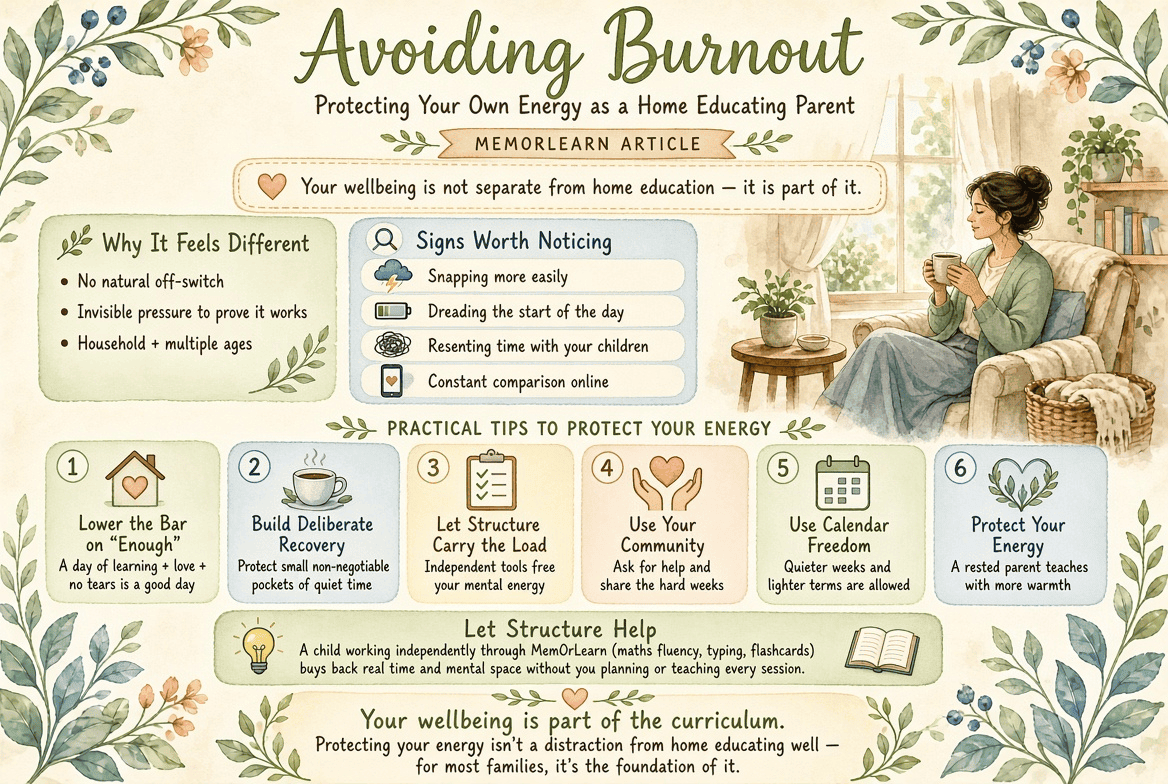
Home education asks a lot of parents. You're teacher, timetable planner, chief motivator, and referee, often for more hours in the day than a school teacher would ever spend with one class. It's no surprise that burnout is one of the most common things that comes up in UK home education groups — usually not from parents who are doing a bad job, but from parents who've been running flat out for months without building in any recovery.
Here's a practical look at what tends to cause it, and what actually helps.
Why Home Educating Parents Burn Out Differently
Unlike a job with defined hours, home education rarely has a natural off-switch. There's no staffroom, no end-of-day bell, no half-term that isn't also just... you, at home, with your children, all the time. Many parents also carry an invisible pressure to prove the decision was the right one — every wobble can feel like evidence against home education itself, rather than just an ordinary hard week that any parent or teacher would have.
Add in running a household, possibly working alongside home educating, and managing multiple children at different ages and stages, and it's easy to see why burnout shows up so often in this particular group of parents.
Signs Worth Paying Attention To
Burnout rarely arrives all at once. It tends to build through a few recognisable signs: snapping more easily over small things, dreading the start of the day rather than feeling neutral about it, resenting time with your own children, or finding yourself constantly comparing your family to others online and coming away feeling worse. None of these mean you're failing — they're signals that something needs to change, usually about pace or support rather than about the fundamental decision to home educate.
Lower the Bar on "Enough"
A huge amount of home educating burnout comes from an invisible, ever-rising bar of what counts as a good enough day. Comparing your household to a highlight reel of someone else's Instagram-perfect nature table is a fast route to feeling permanently behind. A day where your child learned something, felt loved, and nobody ended up in tears (including you) is a genuinely good day, even if it looked nothing like the version in your head that morning.
Build In Deliberate Recovery, Not Just Hoped-For Downtime
Waiting for a quiet moment to spontaneously appear rarely works. What tends to help more is deliberately protecting small, non-negotiable pockets of time — a cup of tea in peace before anyone else is up, a short walk without a child in tow, an evening where you genuinely switch off from planning the next day. These don't need to be large; consistency matters more than duration.
Let Structure Carry Some of the Load
One underrated way to reduce daily decision fatigue is letting some parts of the day run on autopilot rather than needing your active input every time. A child who can sit down and work through a structured maths or typing session independently, without you needing to plan, teach, or mark it in the moment, buys back real time and mental energy. This is one area where a tool like MemOrLearn genuinely earns its place — once it's set up, a child can work through their own session, and you get a small, reliable pocket of the day back without having to build or supervise it from scratch each time.
Use Your Community, Don't Just Observe It
It's easy to scroll through a home education Facebook group passively, absorbing everyone else's wins while never actually posting your own struggles. Parents who ask for help, admit a hard week, or simply say "is anyone else finding this exhausting right now" tend to find far more support than those who quietly compare themselves to everyone else's polished updates. The community is only as useful as your willingness to actually use it.
Remember Term Time Doesn't Need to Mean Constant Output
Autonomy over your own calendar is one of home education's biggest advantages, and it's worth actually using it. A quieter week, a day off when everyone's flagging, or a term that leans lighter than usual isn't a failure of commitment — it's one of the genuine benefits of not being bound to a school calendar. Parents who treat every week as needing to match a full school term's output tend to burn out fastest, precisely because they've recreated school-level pressure without school-level support.
Your Wellbeing Is Part of the Curriculum
It's tempting to think of self-care as separate from, or even in competition with, your child's education. In practice, a parent running on empty teaches worse, has less patience, and enjoys the whole process less — while a parent who's protected some of their own energy tends to bring more warmth and flexibility to the day, even with the same amount of material covered. Protecting your own wellbeing isn't a distraction from home educating well. For most families, it's a precondition for it.