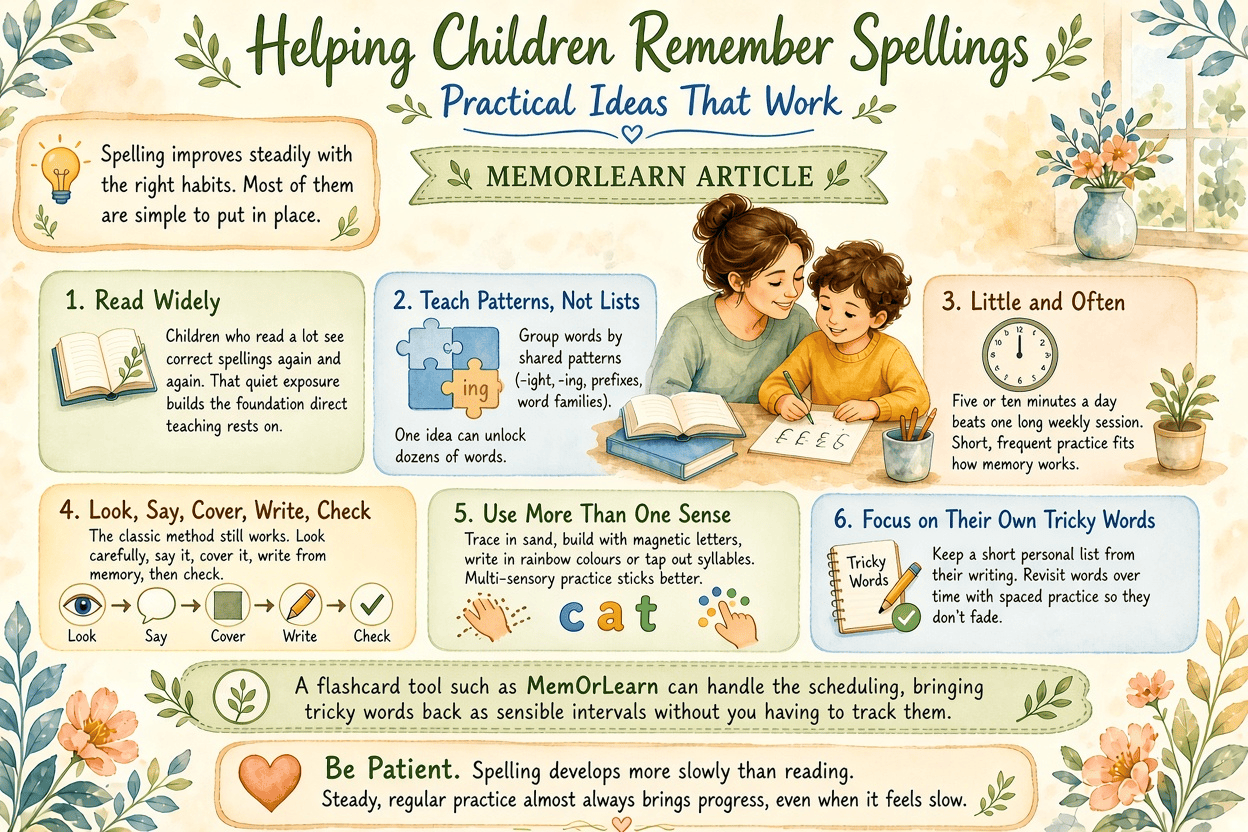
Ask any home educating parent about spelling and you'll often hear the same thing: a child who spelled "because" correctly on Monday and wrote "becos" on Tuesday. English spelling is genuinely tricky, with its silent letters, borrowed words and exceptions to almost every rule. The good news is that spelling improves steadily with the right habits, and most of them are simple to put in place.
Read, Read and Read Some More
Children who read widely see correct spellings again and again, and that exposure quietly builds a sense of what looks right. Reading aloud together, audiobooks followed by the printed book, and plenty of time with books they enjoy all help. It won't fix every error, but it creates the foundation that direct teaching builds on.
Teach Patterns, Not Just Lists
A list of fifty unconnected words is hard to remember. Words grouped by pattern are much easier. Teaching that "-ight" appears in light, night, fight and sight, or how adding "-ing" or "-ed" changes a word, lets a child learn one idea and apply it to dozens of words. Look at prefixes, suffixes and word families too: knowing that "sign" appears in signal and signature helps explain the silent "g". If you'd like a reference point, the statutory word lists for Key Stage 2 are a handy guide to what's commonly expected, though there's no obligation to follow them.
Little and Often
Five or ten minutes a day beats a long weekly spelling session. Short, frequent practice fits much better with how memory works, and it's far less likely to end in groans.
Look, Say, Cover, Write, Check
This classic method has endured for good reason. Your child:
- Looks carefully at the word
- Says it aloud, sometimes breaking it into syllables
- Covers it up
- Writes it from memory
- Checks it against the original
It's simple, it needs no equipment, and it builds the habit of checking their own work.
Use More Than One Sense
Many children remember spellings better when more than their eyes are involved. Try tracing words in sand or a tray of salt, building them with magnetic letters, writing them in rainbow colours, or tapping out the syllables. For children who find paper-based work dull, a change of method can make an old word feel new.
Focus on Their Own Tricky Words
Generic lists have their place, but the words that matter most are the ones your child actually gets wrong. Keep a short, personal list of words from their own writing, and work on a handful at a time. Crossing words off as they become secure gives a satisfying sense of progress.
Revisit Words Over Time
A word learned on Monday and never seen again is likely to be forgotten by the following week. Revisiting it after a day, then a few days, then a couple of weeks, is far more effective than cramming. Flashcards are a good way to do this, whether homemade or digital, and a flashcard tool such as MemOrLearn can handle the scheduling, so tricky words keep coming back at sensible intervals without you having to track them.
Mnemonics for the Stubborn Ones
Some words simply refuse to stick, and a silly memory aid often does the trick. "Necessary" has one collar and two sleeves, and "separate" has "a rat" in the middle. The sillier or more personal the mnemonic, the better it tends to work, and children enjoy inventing their own.
Don't Correct Everything
When a child has just written a story, marking every spelling error can take the joy out of it. Pick a few words to focus on, perhaps ones that follow a pattern you've been learning, and leave the rest. Dictation, where you read out a sentence or two for them to write, is a gentle way to practise spelling in context without the pressure of creating something from scratch.
Be Patient
Spelling tends to develop more slowly than reading, and many children are still making errors well into the upper primary years. Steady, regular practice almost always brings progress, even if it seems slow. Some families like to keep spelling alongside grammar and typing practice, and platforms such as MemOrLearn that combine flashcards, grammar and typing can keep these skills ticking over in one place.