If you've ever crammed for a test and forgotten almost everything a week later, you've already experienced the problem spaced repetition solves. It's the difference between information that sits in your head for a night and information that actually stays there.
Spaced repetition is a learning technique where you review information at gradually increasing intervals — right before you're about to forget it — instead of repeating it over and over in one sitting. It sounds simple, but it's backed by decades of memory research, and it's quietly become the backbone of how top language learners, med students, and now a growing number of homeschool families teach memorisation.
What Does Spaced Repetition Actually Mean?
Here's the core idea: every time you learn something new, your memory of it fades on a predictable curve. If you review it right when it's about to slip away, the memory gets reinforced and the next "forgetting point" pushes further out. Review it again at that new point, and it pushes out further still.
In practice, this means:
- A new flashcard might get reviewed after 1 day, then 3 days, then a week, then a month
- Cards you find easy get spaced out further apart
- Cards you struggle with come back around more often, closer together
The result is that you spend the least amount of time possible on things you already know, and the most time on things that actually need reinforcing — instead of wasting practice time re-reviewing material that's already locked in.
What Are The Benefits of Spaced Repetition?
It moves information into long-term memory, not just short-term. Cramming can get a fact into your head for a day or two. Spaced repetition is specifically designed to push it into durable, long-term storage — which is the difference between "I knew that for the quiz" and "I still know that a year later."
It's dramatically more time-efficient than repetitive drilling. Because the system only brings back what's about to be forgotten, kids aren't wasting minutes re-reading flashcards they've already mastered. Ten well-timed minutes a day tends to outperform an hour of unstructured review.
It works for almost any subject. Vocabulary, Bible verses, historical dates, math facts, grammar rules, science terms — spaced repetition isn't tied to one subject. Any material that needs to be recalled rather than reasoned through benefits from it.
It reduces the frustration of "forgetting everything over the summer." Because review intervals stretch out over weeks and months rather than stopping after a unit test, spaced repetition is naturally suited to retention over the long homeschool year — not just until Friday's quiz.
It builds independent learning habits. Once a child gets used to a short daily review routine, it becomes something they can largely manage themselves, which is a genuinely valuable habit well beyond whatever they're memorising today.
It adapts automatically to each child. A good spaced repetition system doesn't need a parent to manually decide what to review next — it tracks what each child finds hard and adjusts the schedule on its own, which matters a lot in a homeschool where one parent may be managing several kids at different levels.
A Few Things Worth Knowing:
Spaced repetition is built for memorisation — facts, vocabulary, definitions, verses — not for building deep conceptual understanding on its own. A child can perfectly recall that "photosynthesis converts sunlight into energy" through spaced review while still needing separate instruction to actually understand why or how. It's a tool for retention, best paired with real teaching, not a replacement for it.
It also requires a bit of consistency to work well. Because the whole system is built around reviewing things right as they're about to be forgotten, skipping several days in a row can mean a pile of overdue cards waiting when a child comes back — which can feel discouraging if it happens often. Short, daily sessions work far better than long, irregular ones.
Finally, not every spaced repetition tool is built the same. Some apps (like Anki, which many homeschool families start with) are powerful but require a fair amount of manual setup — building your own decks, tagging cards, tweaking algorithms — which can be more technical than a busy homeschool day has room for.
Well, How Can You Bring Spaced Repetition Into a Homeschool Day?
The appeal for homeschooling specifically is that spaced repetition turns memorisation into a short, low-effort daily habit rather than a dreaded study session — which fits naturally into a morning routine alongside math or reading time.
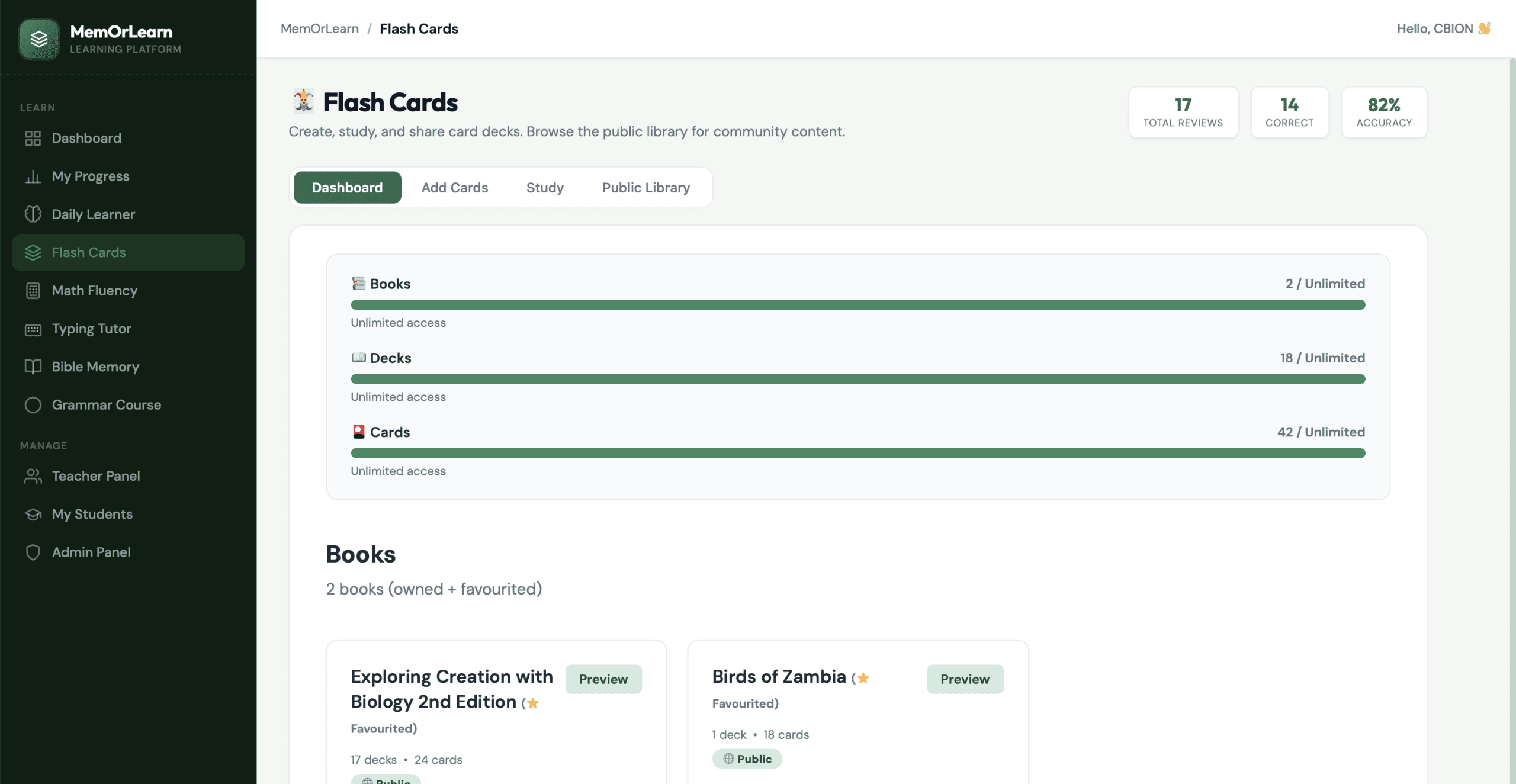
MemOrLearn's Flashcards module is built on spaced repetition from the ground up, so instead of manually building decks and guessing at review timing, cards are scheduled automatically based on what each child is ready to review next, you just need to come back and get started each time and MemOrLearn does the hard part!
If you've already read our piece on Anki alternatives for homeschoolers, this is the concept underneath why those tools work in the first place — and why finding the right one matters as much as the technique itself. See our article here: Best Anki Alternatives for Homeschoolers in 2026
Visit memorlearn.com or see our pages below:
Facebook: MemOrLearn FaceBook Page
Reddit: MemOrLearn Reddit Community