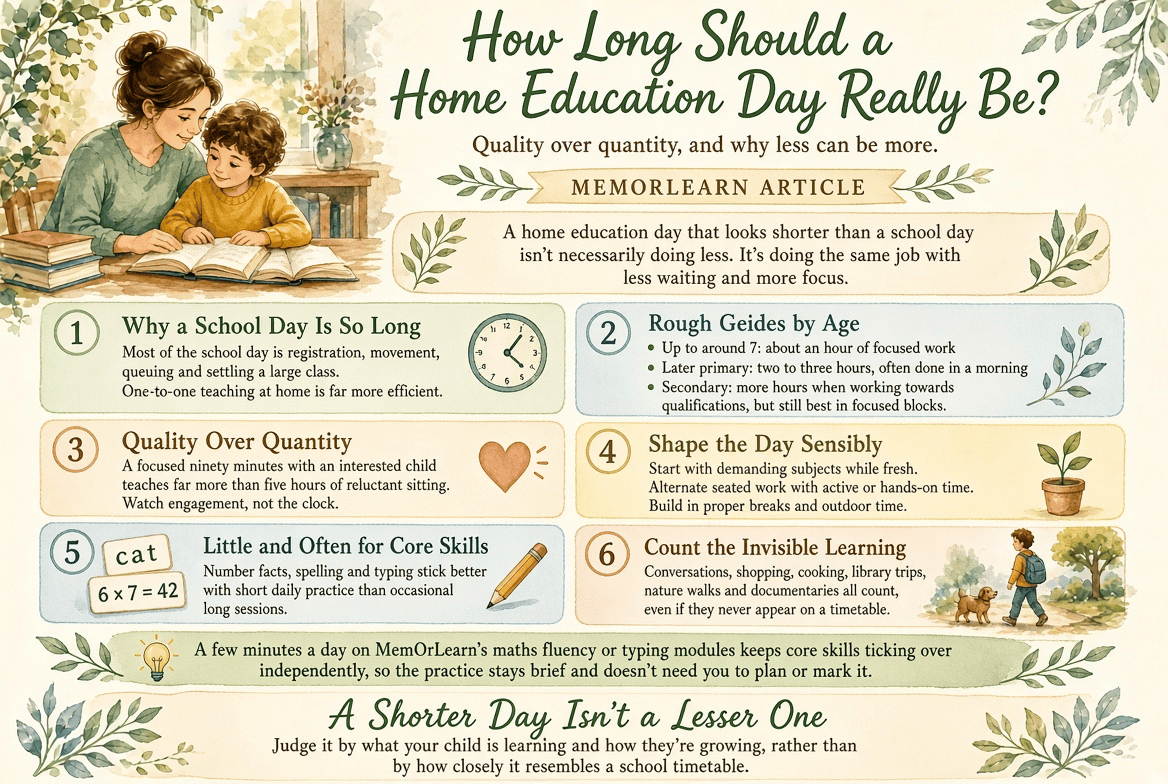
One of the first worries new home educators voice is whether they're doing enough, and it's usually measured against the length of a school day. If your lessons finish by lunchtime while friends' children are at their desks until three, it's easy to feel you're falling short. In reality, the two aren't comparable, and understanding why can take a lot of the pressure off.
Why a School Day Is So Long
A school day isn't six hours of teaching. It includes registration, assemblies, moving between classrooms, queuing for lunch, settling a class of thirty and waiting for everyone to finish. Teaching one, two or three children at home removes most of that, and one-to-one teaching is highly efficient. A child can often cover in an hour what takes a classroom morning.
Rough Guides by Age
There's no single right answer, but many families find a pattern like this works well:
- Up to around seven: about an hour of focused work a day, with the rest given to play, stories, outdoor time and conversation
- Later primary years: two to three hours of more focused work, often comfortably done in a morning
- Secondary age: usually more, particularly when working towards qualifications, though a few concentrated hours often beats a long day of half-attention
Treat these as starting points rather than targets. Every child, and every family, is different.
Quality Over Quantity
A focused ninety minutes with an interested child will teach far more than five hours of reluctant sitting. If concentration is fading, it's usually a sign to stop or change activity rather than push through. Watching your child's engagement tells you more than watching the clock.
When the Day Needs to Run Longer
As children get older, longer days become both possible and necessary. Teenagers working towards GCSEs or other qualifications will usually need several hours of study, plus time for independent reading and revision. Even then, it helps to build the day in blocks with real breaks between them, and to protect time for sleep, exercise and friends, since tired, overloaded teenagers rarely learn efficiently. Extending the day gradually, rather than jumping straight to a full timetable, makes the change much easier for everyone.
Shape the Day Sensibly
How the day is arranged matters as much as its length. Many families find it helps to:
- Tackle the most demanding subjects first, while everyone is fresh
- Alternate seated work with something active or hands-on
- Leave creative, practical or outdoor activities for later in the day
- Build in proper breaks, and a decent stretch of time outdoors
Little and Often for Core Skills
Number facts, spelling and typing tend to stick better with short daily practice than with occasional long sessions. A few minutes a day fits into even the lightest timetable, and a tool such as MemOrLearn can provide short, structured sessions in maths fluency and typing that a child can work through independently, so the practice stays brief and doesn't need you to plan or mark it.
Count the Learning That Doesn't Look Like Lessons
Learning doesn't stop when the books are closed. Conversations in the car, helping with the shopping, a trip to the library, cooking together, an afternoon at the park spotting wildlife and an evening documentary all contribute, even though none of them would appear on a timetable. Many experienced home educators say that this "invisible" learning is a large part of what makes home education work.
Check In Occasionally
Rather than counting hours, a better question to ask now and then is whether your child is making steady progress and enjoying learning. Keeping a few simple notes, or looking at progress records from a platform such as MemOrLearn, can reassure you that things are moving forward even on days that feel short.
A Shorter Day Isn't a Lesser One
A home education day that looks shorter than a school day isn't necessarily doing less. It's doing the same job with less waiting and more focus. Give yourself permission to judge it by what your child is learning and how they're growing, rather than by how closely it resembles a school timetable.