Ask most home educating parents about their curriculum, and you'll hear detailed plans for maths, English, and topic work. Ask about typing, and you'll often get a shrug — it's the subject that tends to happen by accident, if it happens deliberately at all. Given how much of both education and later working life runs through a keyboard, it's worth giving typing a bit more intentional attention than "they'll pick it up eventually."
Why It's Worth Teaching Properly, Not Just Absorbing Informally
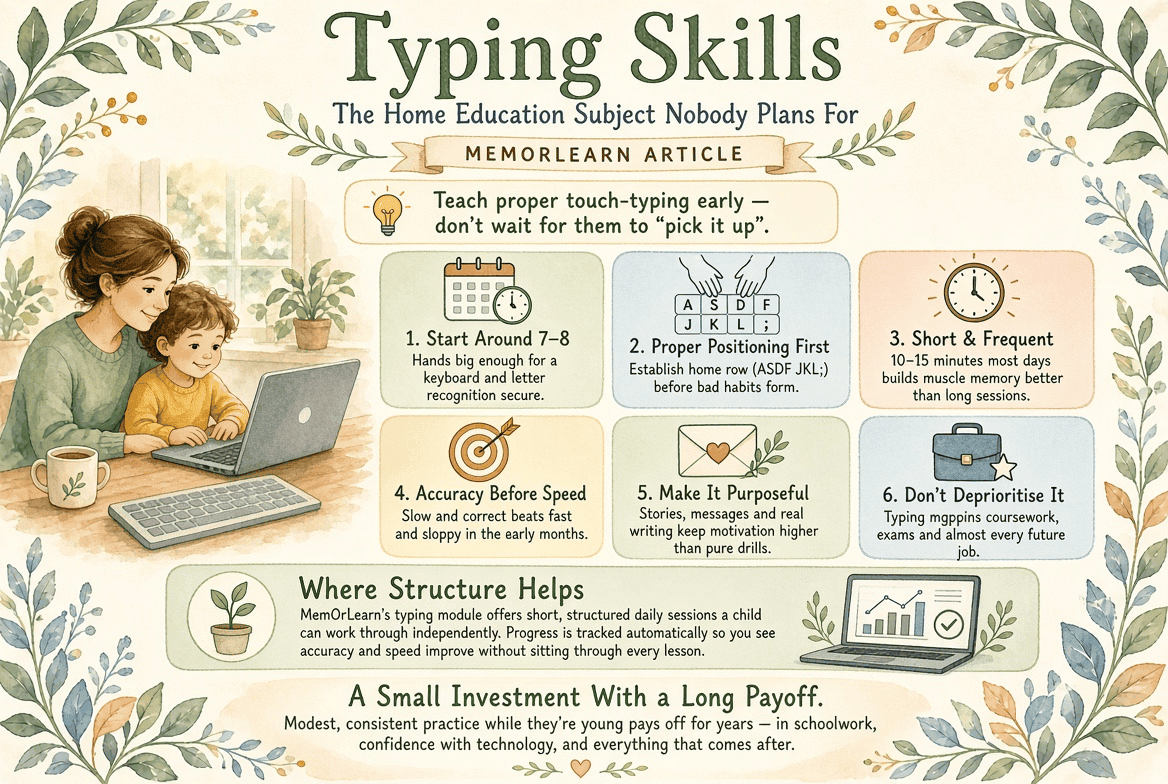
Most children do eventually learn to type simply through exposure — games, messaging, schoolwork typed up on a laptop. The trouble is that unguided typing almost always settles into a slow, two-finger "hunt and peck" habit that's genuinely hard to unlearn later. A child who learns proper touch-typing early, by contrast, ends up typing faster, more accurately, and without needing to look at the keyboard — a skill that pays dividends for years, from secondary school essays to eventual employment.
The Best Age to Start
There's no strict rule, but most children can meaningfully start structured typing practice from around seven or eight, once their hands are a reasonably comfortable size for a standard keyboard and they're already comfortable with letter recognition. Starting properly at this stage — rather than waiting until GCSE coursework or college applications force the issue — gives plenty of time for the skill to become genuinely automatic well before it's urgently needed.
Teach Proper Finger Positioning From the Start
The single biggest factor in whether typing practice actually pays off long-term is whether correct finger positioning gets established early. Once a child has spent a year or two happily two-finger typing, retraining proper technique is considerably harder than starting correctly the first time. A few minutes spent establishing home row position (fingers resting on ASDF and JKL;) and which finger handles which key, right at the start, saves a great deal of difficulty later.
Keep Sessions Short and Frequent
As with most skill-building, short daily sessions beat occasional long ones. Ten to fifteen minutes most days builds muscle memory far more effectively than an hour once a week, and it's short enough that it rarely becomes a battle to start.
Prioritise Accuracy Before Speed
It's tempting to chase impressive words-per-minute numbers early on, but accuracy built first tends to produce genuinely faster typists in the long run. A child who's rushed into speed often locks in bad habits — looking at the keyboard, using the wrong fingers, developing a personal "system" that's hard to shift later. Slow and correct beats fast and sloppy, especially in the first few months. MemOrLearn's beginner typing lessons are built around exactly this principle, deliberately pacing early sessions toward accuracy rather than speed, so a child builds correct habits first and only picks up pace naturally once those habits are secure.
Make It Purposeful, Not Just Drills
Pure drill exercises (repeating "asdf asdf asdf") have their place early on, but typing practice tends to stick better once it connects to something a child actually wants to type — a story, a message to a grandparent, notes on a topic they're interested in. Where possible, blending structured practice with genuinely purposeful typing keeps motivation higher than drills alone ever manage.
Don't Skip It Because It Feels Less Academic
It's easy to deprioritise typing because it doesn't feel like a "real" subject in the way maths or English does, especially when home education time already feels stretched. But typing underpins nearly everything that follows — coursework, GCSE exam software in some cases, university work, and most forms of employment now assume reasonable typing competence as a given, rarely teaching it explicitly at any stage.
Where Structured Practice Helps
Typing is one of those skills that benefits enormously from consistent, low-effort daily practice — exactly the kind of thing that's easy to intend and surprisingly easy to let slip without some structure behind it. MemOrLearn's typing module is built around exactly this: short, structured daily sessions that a child can work through independently once shown the basics, with progress tracked automatically so you can see accuracy and speed improving over time without needing to sit and supervise every session.
For families juggling several subjects already, having one area a child can genuinely manage independently — checking in occasionally rather than teaching directly — frees up time and attention for the subjects that do need more hands-on involvement.
A Small Investment With a Long Payoff
Typing rarely feels urgent, which is exactly why it's so often left until later, or never taught deliberately at all. A modest, consistent investment of time while a child is still young pays off for years afterward — in schoolwork, in confidence with technology generally, and eventually in whatever comes after home education itself. It's a subject worth genuinely planning for, not just hoping happens along the way.