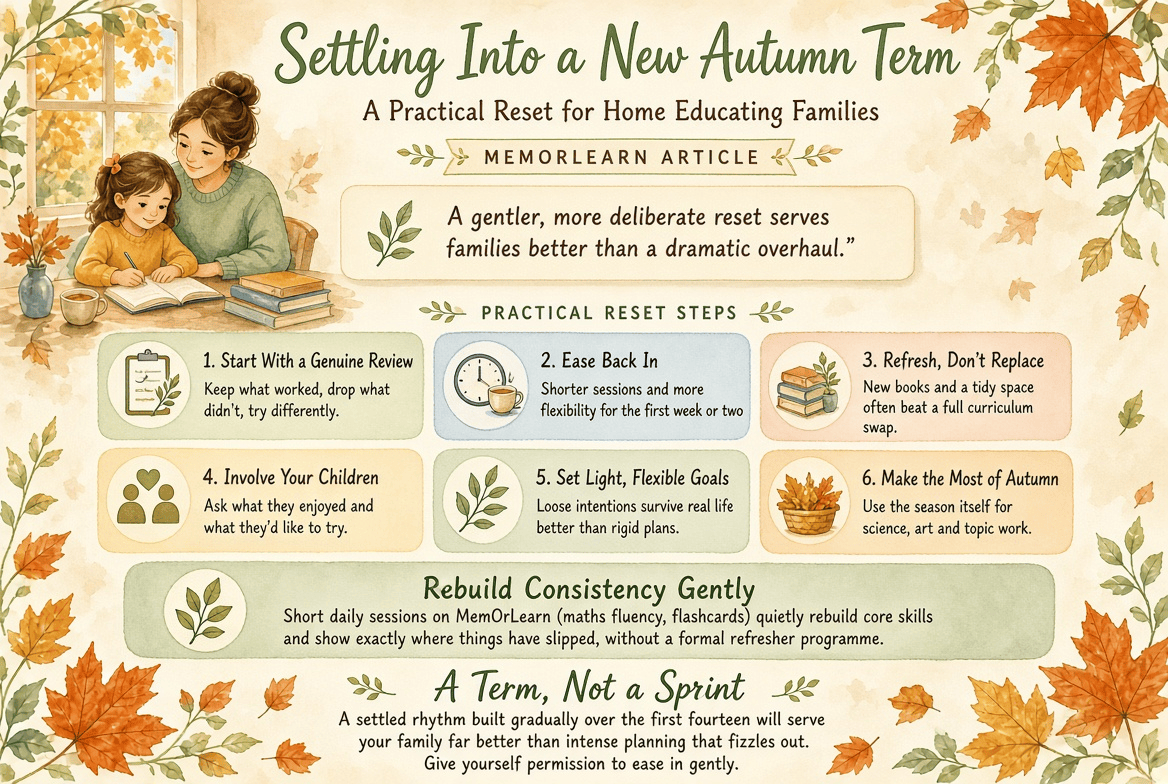
There's something about September that makes even the most relaxed home educating household feel the pull of a fresh start. The shops are full of stationery, the light's changing, and after a loose, sun-soaked summer holidays, it's tempting to swing hard into a brand new routine on day one. In practice, a gentler, more deliberate reset tends to serve families better than a dramatic overhaul.
Here's a practical way to approach it.
Start With a Genuine Review, Not Just a Fresh Timetable
Before planning anything new, it's worth an honest look back at last term. What actually worked? What got abandoned within a fortnight and quietly never mentioned again? Home educating families often carry forward a routine simply because it's what they had, rather than because it was genuinely serving anyone. A ten-minute review — what to keep, what to drop, what to try differently — is far more useful than jumping straight to a new colour-coded timetable.
Ease Back In Rather Than Diving Straight to Full Pace
After weeks of unstructured summer days, children (and honestly, parents) rarely transition smoothly straight back into a full six-hour learning day. A gentler first week or two — shorter sessions, a bit more flexibility, easing core subjects back in before adding everything else — tends to produce a smoother, less resentful start than expecting full pace from day one.
Refresh, Don't Necessarily Replace
New term energy often tempts parents into buying an entirely new curriculum or resource set, when what's actually needed is a smaller refresh: new exercise books, a tidied workspace, a couple of new resources to complement what's already working well. Wholesale replacement is rarely necessary just because the calendar's turned over, and it can add unnecessary cost and disruption on top of an already busy month.
Involve Your Children in the Reset
Children, even young ones, often have surprisingly clear opinions about what they enjoyed and what they didn't. A short, informal conversation — what was your favourite thing we did last term, what was boring, what would you like to try this year — can shape a term plan that your child is genuinely invested in, rather than one handed down entirely from above.
Set Light, Flexible Goals Rather Than a Rigid Plan
Rather than mapping out every week of the term in detail, many families find it more sustainable to set a handful of loose intentions: perhaps a particular skill to strengthen, a topic to explore, or simply a general shape to the week (which days lean more structured, which stay looser). A plan with room to breathe survives contact with real life far better than one that assumes every day will go exactly as scripted.
Make the Most of Autumn Itself
One advantage of not being tied to a school calendar is the freedom to actually make use of the season rather than just enduring it from a classroom window. Autumn offers plenty of genuinely educational material on its own doorstep — changing leaves, harvest, shorter days, seasonal produce, bonfire night traditions — all of which can fold naturally into science, art, and topic work without needing a formal curriculum to justify it.
Rebuild Consistency Gently for Core Skills
Core skills like maths fluency, reading, and spelling are often the first things to slip during a long summer break, simply through lack of regular practice. Rather than a sudden return to full drilling, a gentle, short daily reintroduction tends to rebuild consistency without the frustration of a child feeling like they've "forgotten everything."
This is somewhere a structured tool genuinely helps ease the transition. A short daily session on something like MemOrLearn's maths fluency or flashcard modules can quietly rebuild momentum over the first couple of weeks, without needing a parent to plan a formal refresher programme from scratch. Because progress is tracked automatically, you'll also get a quick, honest sense of exactly where things have slipped and where they haven't — useful information for shaping the rest of the term.
A Term, Not a Sprint
It's worth remembering that a home education year is considerably longer and more flexible than a school term, so there's rarely any need to have everything perfectly resolved in the first week of September. A settled, sustainable rhythm built gradually over the first fortnight will serve your family far better over the coming months than a burst of intense planning that fizzles out by the second week.
Whatever shape this term takes, giving yourself permission to ease in gently — rather than matching an imagined ideal from day one — tends to be the single most useful thing any home educating parent can do each September.