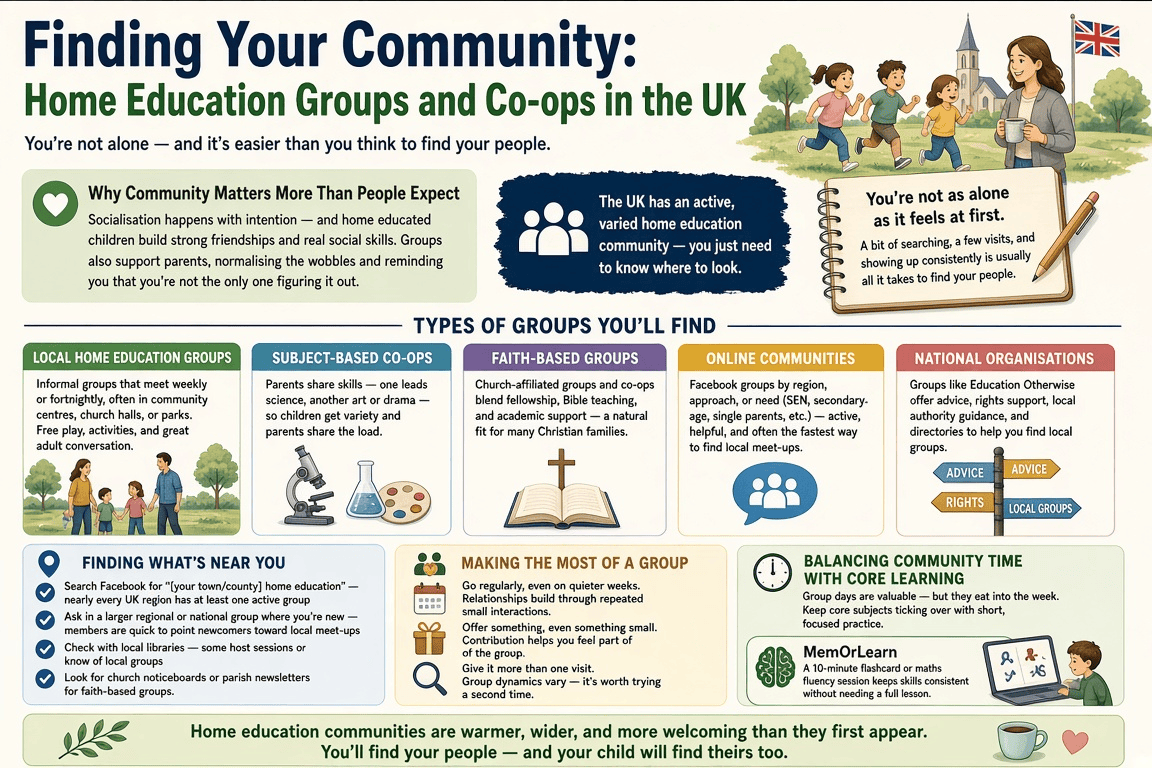
One of the questions new home educating parents ask most often isn't about curriculum or the law — it's "will my child actually see other children?" It's a fair worry, and one of the most persistent myths about home education is that it means isolation. In reality, the UK has a genuinely active, varied home education community, and finding your place in it is often more straightforward than it first appears, once you know where to look.
Why Community Matters More Than People Expect
Socialisation comes up constantly in conversations about home education, sometimes from well-meaning relatives, sometimes from your own quiet worry at ten o'clock at night. The honest answer is that home educated children can and do build strong friendships and social skills — but it usually takes a bit more intention than it would at school, simply because the ready-made peer group of a classroom isn't there by default.
The good news is that intention is easy to act on once you know what's available. Beyond friendships for your child, a support network does something equally valuable for parents: it normalises the wobbles. Every home educating parent has a week where they wonder if they're doing enough — a group of people who've been there before is often more reassuring than any amount of research.
Types of Groups You'll Find
Local home education groups. Most towns and cities have at least one informal group that meets weekly or fortnightly, often in a church hall, community centre, or park in good weather. These tend to be loosely structured — free play, occasional group activities, and plenty of adult conversation while children run around.
Subject-based co-ops. Some groups organise around specific subjects, with parents each contributing a skill — one running a science club, another leading art or drama — so children get variety and parents share the teaching load rather than each covering everything alone.
Faith-based groups. For Christian home educating families in particular, church-affiliated groups and co-ops are common across the UK, often blending fellowship, Bible teaching, and academic support in the same setting. These can be a natural fit for families already weaving faith into their daily learning routine.
Online communities. Facebook groups organised by region, approach (structured, autonomous, faith-based), or specific need (SEN, secondary-age, single parents home educating) are enormously active in the UK, and often the fastest way to get a question answered or find your nearest local meet-up.
National organisations. Groups like Education Otherwise offer broader support, advice on rights and local authority interactions, and directories that can point you toward local groups you might not find through a casual search.
Finding What's Near You
A few practical starting points if you're new to an area or just starting out:
- Search Facebook for "[your town/county] home education" — nearly every UK region has at least one active group
- Ask in a larger regional or national group where you're new — established members are usually quick to point newcomers toward local meet-ups
- Check with local libraries, some of which host home education-friendly sessions or know of local groups
- Look for church noticeboards or parish newsletters if you're seeking a faith-based group specifically
Making the Most of a Group Once You've Found One
Turning up once is easy; building real friendships takes a bit more consistency. A few things that help:
Go regularly, even on quieter weeks. Relationships, for parents and children alike, tend to build through repeated small interactions rather than a single big event.
Offer something, even something small. Groups and co-ops run on parent contribution — offering to lead an activity, bring a game, or simply help with setup goes a long way toward feeling like part of the group rather than a visitor.
Give it more than one visit. Group dynamics vary hugely, and a first visit doesn't always reflect the full picture. If the first group you try doesn't feel right, it's worth trying a second before concluding home ed groups "aren't for us."
Balancing Community Time With Core Learning
Group days are valuable, but they do eat into the week — which is exactly where having an efficient, low-effort way to keep core subjects ticking over matters. Many families use the days around group meet-ups for lighter, more independent practice, so a big group day doesn't mean maths or reading gets skipped entirely.
This is somewhere a tool like MemOrLearn earns its keep: a child can complete a focused ten-minute flashcard or maths fluency session at home before heading out to a group, keeping core skills consistent without needing a full formal lesson squeezed in around a busy social day. It's a small thing, but it takes the pressure off treating community days as "lost" learning time.
You're Not as Alone as It Feels at First
The early weeks of home education can feel quiet, especially if you've moved to a new area or don't yet know anyone else doing this. But the UK home education community is larger, more varied, and more welcoming than it first appears from the outside. A bit of searching, a few visits, and a willingness to show up consistently is usually all it takes to go from feeling isolated to feeling like you've found your people.