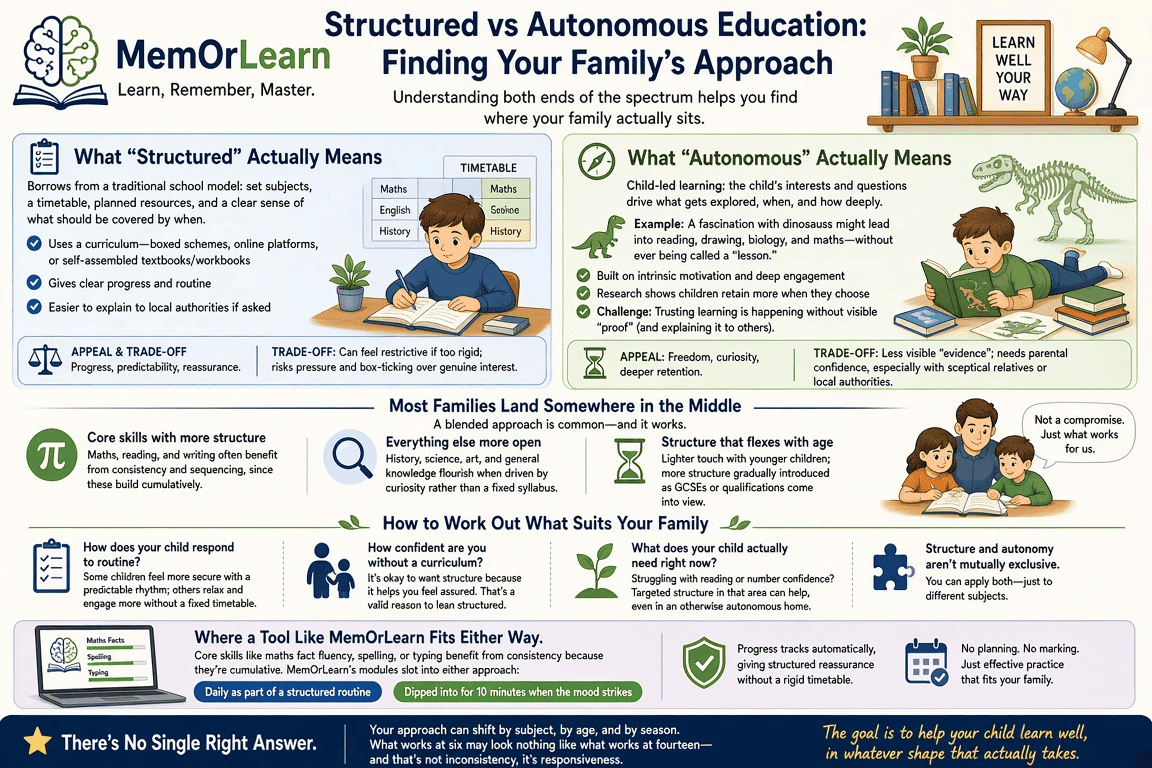
Spend any time in UK home education circles — Facebook groups, local meet-ups, forums — and you'll quickly notice a divide that comes up again and again: structured versus autonomous education. It's often talked about as though families must pick a side and stay there, but in practice, most home educating households end up somewhere in between, and understanding both ends of the spectrum helps you work out where your family actually sits.
What "Structured" Actually Means
A structured approach borrows more from a traditional school model: set subjects, a timetable, planned resources, and a rough sense of what should be covered by when. Parents following this route often use a curriculum, whether that's a boxed scheme, an online platform, or a self-assembled mix of textbooks and workbooks.
The appeal is straightforward: it gives both parent and child a clear sense of progress, it's easier to explain to a local authority if asked, and it suits children who thrive on routine and predictability. The trade-off is that it can feel restrictive if imposed too rigidly, and it risks recreating the very things some families left school to avoid — pressure, pacing set by someone else, and learning driven by ticking boxes rather than genuine interest.
What "Autonomous" Actually Means
Autonomous education (sometimes called child-led learning) sits at the other end. Rather than a set curriculum, the child's own interests and questions drive what gets explored, when, and how deeply. A fascination with dinosaurs might lead into reading, drawing, basic biology, even maths (counting bones, comparing sizes) without ever being labelled as a "lesson."
Advocates of this approach point to research on intrinsic motivation — children tend to retain and engage more deeply with material they've chosen to pursue themselves, compared to material handed to them on a schedule. The challenge, particularly for parents newer to home education, is trusting that meaningful learning is genuinely happening without the reassurance of a workbook full of completed pages. It also takes a certain amount of parental confidence to explain an autonomous approach to sceptical relatives, or occasionally to a local authority officer more used to seeing structured evidence.
Most Families Land Somewhere in the Middle
In practice, very few UK home educating families sit purely at either extreme. A common pattern looks something like this:
- Core skills handled with more structure — maths, reading, and writing often benefit from some consistency and sequencing, since these tend to build cumulatively
- Everything else left more open — history, science, art, and general knowledge often flourish better when driven by genuine curiosity rather than a fixed syllabus
- Structure that flexes with age — many families use a lighter touch with younger children and introduce more structure gradually as GCSEs or other qualifications come into view during the teenage years
This blended approach isn't a compromise or a failure to commit — for most children, it's simply what works.
How to Work Out What Suits Your Family
A few honest questions can help you find your own balance, rather than adopting someone else's wholesale:
How does your child respond to routine? Some children feel more secure with a predictable daily rhythm; others visibly relax and engage more once the pressure of a fixed timetable is removed.
How confident are you without a curriculum guiding you? There's no shame in wanting more structure simply because it makes you, the parent, feel more assured that things are on track. That's a legitimate reason to lean structured, separate from what's "best" in the abstract.
What does your child actually need right now? A child struggling with reading fluency or number confidence often benefits from consistent, structured practice in that specific area, even within an otherwise autonomous household. Structure and autonomy aren't mutually exclusive — you can apply both, just to different subjects.
Where a Tool Like MemOrLearn Fits Either Way
Whichever end of the spectrum your family leans toward, core skills like maths fact fluency, spelling, or typing tend to benefit from some consistency, simply because they're cumulative — each new concept builds on the last. This is one area where even strongly autonomous families often introduce a bit more structure deliberately.
MemOrLearn's modules are built to slot into either approach: used daily as part of a structured routine, or dipped into for ten minutes whenever a child is in the mood to practise, without a parent needing to plan or mark anything. Because progress tracks automatically in the background, you get the reassurance structured families want, without imposing a rigid timetable on a child who might do better with more freedom.
There's No Single Right Answer
The structured-versus-autonomous debate can feel oddly high-stakes in home education circles, but it doesn't need to be. Your family's approach can shift by subject, by age, and by season — what works when your child is six may look nothing like what works at fourteen, and that's not inconsistency, it's responsiveness. The goal was never to pick a philosophy and defend it; it was to help your child learn well, in whatever shape that actually takes.