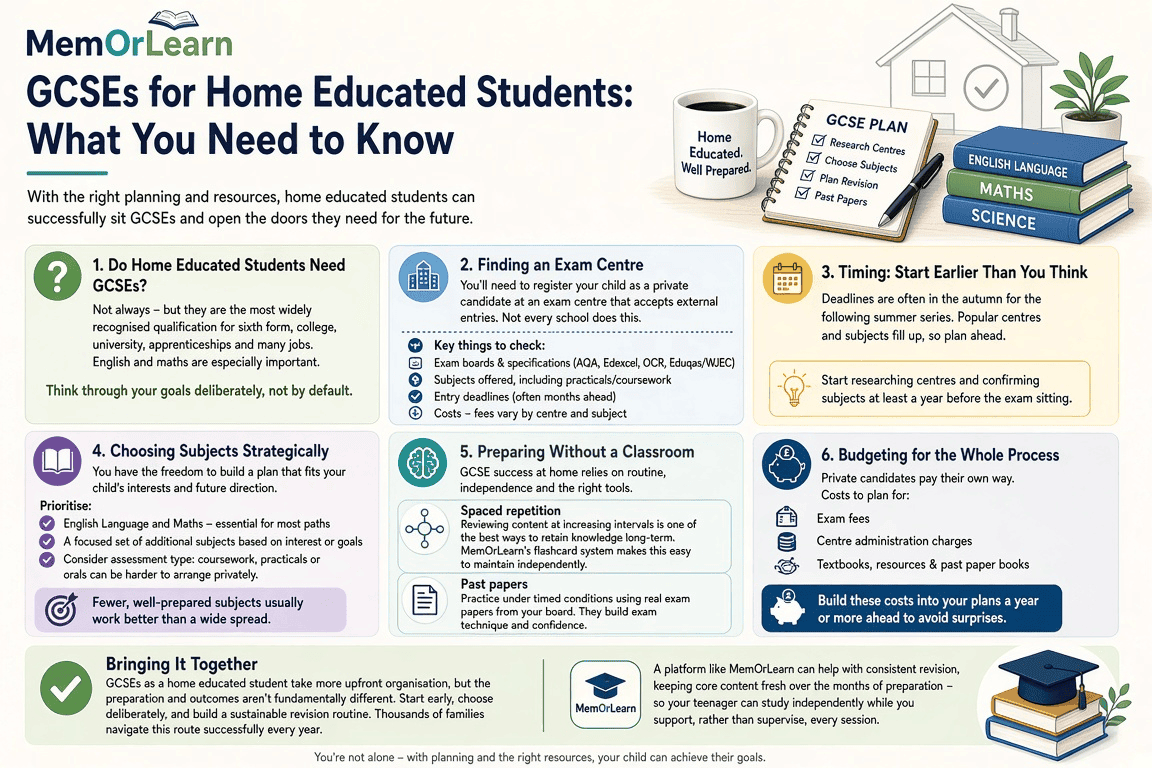
For many UK home educating families, GCSEs eventually become the big question mark on the horizon. Unlike school pupils, home educated students aren't automatically entered for exams by an institution — so the whole process, from choosing subjects to sitting the papers, falls to the family to organise. It sounds daunting at first, but thousands of home educated students sit GCSEs every year, and the path is more established than most parents expect.
This guide covers how the process actually works, what to plan for, and when to start.
Do Home Educated Students Need GCSEs?
Not necessarily. Some families opt for alternative qualifications, apprenticeship routes, or simply let their teenager's chosen path (university, a trade, self-employment) dictate what's actually needed. But for many routes — particularly sixth form, college, and most university pathways — GCSEs in English and maths especially remain the most widely recognised currency, so it's worth thinking through deliberately rather than by default.
Finding an Exam Centre
Because your child isn't enrolled at a school, you'll need to register them as a private candidate at an exam centre that accepts external entries. Not every school does this, so it's worth researching early — many families use dedicated independent exam centres that specialise in home educated and private candidates, rather than approaching mainstream schools directly.
A few things to check when choosing a centre:
- Which exam boards and specifications they offer (AQA, Edexcel, OCR, and Eduqas/WJEC all differ slightly in content)
- Whether they offer the specific subjects you're planning, including any practical or coursework components (some subjects, like sciences with practical assessments, are harder to arrange as a private candidate)
- Entry deadlines, which are often months before the exam itself
- Costs, since private candidates typically pay exam fees directly, and these vary by centre and subject
Timing: Start Earlier Than You Think
Exam entry deadlines are usually set well in advance of the exam dates themselves — often the autumn before a summer exam series. Centres also fill their available places, so leaving this until the new year can mean your first-choice centre is already full for certain subjects. A good rule of thumb is to start researching centres and confirming subject choices at least a year ahead of the intended exam sitting.
Choosing Subjects Strategically
Without a school timetable dictating subject choice, home educating families have real freedom here — but that freedom works best with a plan. Most students benefit from:
- English Language and Maths as a strong baseline, since these are the two most widely required by employers, colleges, and further qualifications
- A small, focused set of additional subjects based on genuine interest or future direction, rather than trying to replicate a full school timetable of eight or nine GCSEs
- Practical considerations, like whether a subject requires coursework, practical assessment, or oral components that are harder to arrange outside a school setting
Fewer, well-prepared subjects usually serve a home educated student better than a large spread taken on thinly.
Preparing Without a Classroom
The biggest shift for most families isn't logistical, it's structural: without daily lessons and set homework, GCSE preparation needs a routine the student can largely follow independently, especially in the final year before exams.
This is where consistent, low-friction revision tools genuinely earn their place. Spaced repetition — reviewing key facts and concepts at increasing intervals rather than cramming — is one of the best-evidenced revision methods for exam-style recall, and it's exactly the kind of thing that's hard to keep up manually but easy to sustain with the right tool. MemOrLearn's flashcard system, for instance, is built around this approach, which makes it a natural fit for a teenager working through GCSE content sets somewhat independently, with a parent checking in rather than teaching every session directly.
Past papers are the other essential ingredient — exam boards publish these freely, and working through them under timed conditions is one of the most reliable ways to prepare for the actual format of the exam, not just the content.
Budgeting for the Whole Process
It's worth going in with clear eyes on cost: private candidate exam fees, centre administration charges, and any required textbooks or resources add up faster than many families expect, and unlike school pupils, home educators generally cover these directly. Building this into your planning a year or more ahead avoids an unpleasant surprise closer to exam season.
Bringing It Together
GCSEs as a home educated student take more upfront organisation than they do for a school pupil, but the actual preparation and outcome aren't fundamentally different — thousands of families navigate this route successfully every year. The keys are starting early on exam centre research, choosing a focused subject set deliberately, and building a sustainable revision routine well before the final run-up to exams.
A platform like MemOrLearn can help with that last part specifically, giving a structured way to keep core content fresh over the months of preparation, without requiring a parent to sit alongside every single revision session.